PT-141 bremelanotide: Receptors and structural evidence
A guide to PT-141 bremelanotide identity, receptor pharmacology, structural information gaps, and research history.
ALORA Research editorial teamPublished Last reviewed 7 min read
The short answer
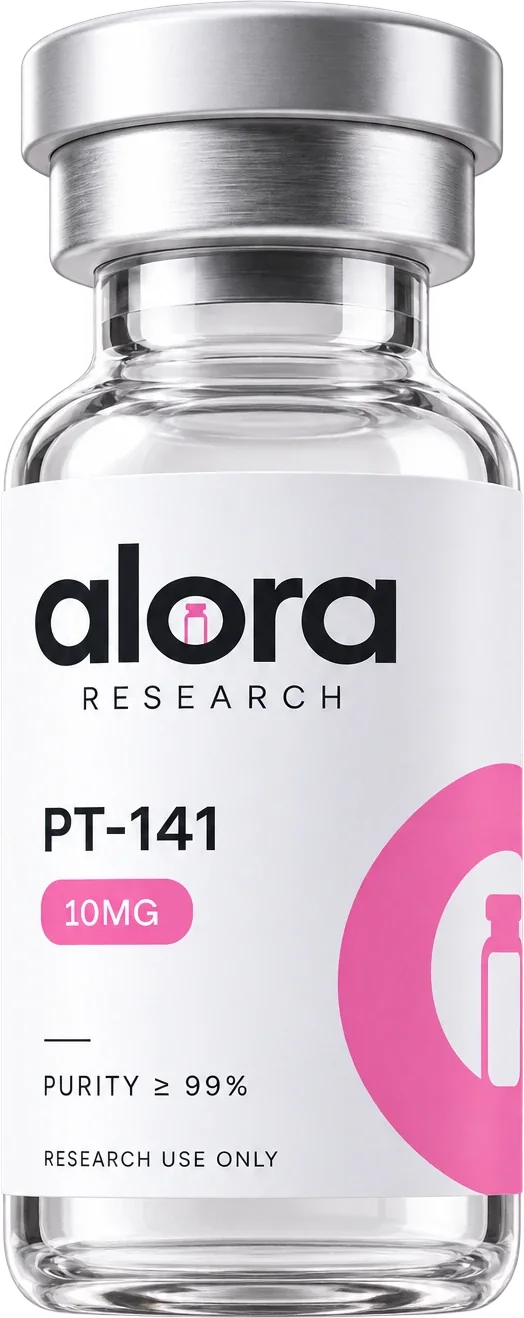
PT-141 (bremelanotide) is a synthetic peptide analog of alpha melanocyte-stimulating hormone and a melanocortin receptor agonist. The development-review abstract describes high affinity for the melanocortin type 4 receptor but reports no numerical comparison across receptor subtypes. The development and early research review abstracts do not establish a complete amino acid sequence, detailed ring structure, or quantitative receptor-subtype selectivity.
Key facts
- Research class
- Melanocortin receptor agonist, as described in a development review [1]
- Peptide relationship
- Synthetic analog of alpha melanocyte-stimulating hormone [1]
- Receptor evidence
- High affinity for melanocortin type 4 receptor, reported qualitatively in a review [1]
- Early lineage
- Modified PT-14 analog in Hedlund's review [2]
- Mechanistic status
- Receptor-specific intracellular signaling is not established by the mechanism-review abstract [3]
- Human study design
- Randomized, double-blind, placebo-controlled phase 3 research [4]
- Catalog code
- ALO-P-022
- Molecular weight
- 1025.2 g/mol
- Classification
- Research peptide — laboratory use only
What is PT-141 bremelanotide?
The development review describes bremelanotide, cataloged as PT-141 (Bremelanotide), as a synthetic peptide analog of alpha melanocyte-stimulating hormone (α-MSH) and a melanocortin receptor agonist. [1]
A peptide is a molecule built from linked amino acid units. An analog is a modified relative of a reference molecule. An agonist is a molecule that activates a receptor. These terms distinguish molecular identity, chemical relationship, and receptor activity; they do not provide a complete chemical specification.
The development review identifies α-MSH as a neuropeptide hormone and describes bremelanotide's relationship to it, but its abstract does not provide an amino acid sequence or structural drawing. [1] Hedlund's early research review describes PT-141 more specifically as a synthetically modified analog of PT-14, also without reporting a sequence in the abstract. [2]
The review literature therefore supports an analog relationship and a receptor-agonist classification more directly than it supports a detailed structural reconstruction from the abstracts. [1, 2]
Is PT-141 selective for MC3R or MC4R?
The development review reports high affinity for the melanocortin type 4 receptor (MC4R), but its abstract does not establish a quantitative selectivity comparison with the melanocortin type 3 receptor (MC3R). [1]
Binding affinity describes how strongly a molecule interacts with a receptor in a binding assay. Functional potency describes the concentration associated with a defined response in a functional assay. Functional efficacy describes the response achieved in that assay. These are different measurements, so a qualitative affinity statement should not be read as a numerical potency or efficacy result.
| Receptor or claim | Binding evidence | Functional evidence | Assay-system detail |
|---|---|---|---|
| MC4R | High affinity described qualitatively in the development review [1] | No receptor-specific potency or efficacy value in the abstract [1] | Binding system and endpoint not specified in the abstract [1] |
| MC3R | No receptor-specific affinity value in the development review abstract [1] | No receptor-specific potency or efficacy value in the abstract [1] | No MC3R assay system described in the abstract [1] |
| Melanocortin receptor family | No comparative affinity panel in the development review abstract [1] | Agonist classification reported at the receptor-family level [1] | No matched receptor-by-receptor experiment described in the abstract [1] |
The distinction is important: the development review supplies a qualitative MC4R affinity statement, not an original comparative binding experiment in its abstract. [1] The mechanism review likewise does not provide a numerical receptor-subtype comparison in its abstract. [3]
What does bremelanotide's mechanism of action mean?
The development and mechanism reviews identify melanocortin receptor agonism but do not map receptor-specific intracellular signaling in their abstracts. [1, 3]
Signaling means the molecular events associated with receptor activation. A downstream event is a later event in that sequence. A proposed pathway and a directly measured signaling event are different levels of evidence.
The mechanism review discusses proposed action and human research, but its abstract does not identify a cell-based experiment that connects a particular melanocortin receptor to a specified intracellular signal. [3] The development-review abstract does not present a receptor-to-intracellular-signal experiment. [1]
A registered phase 4 study (see registry record) lists randomized allocation, quadruple masking, bremelanotide and placebo, and completed status. [5] Its sponsor class is listed as OTHER. [5] That registry record describes a study design; it does not report a receptor-subtype binding panel or a resolved intracellular signaling sequence. [5]
Keep proposed mechanisms, measured receptor pharmacology, and registry design facts separate when reading the research record.
What is known about the amino acid sequence and structure?
A complete amino acid sequence and cyclization map are not reported in the development review or Hedlund's review abstract. [1, 2]
An amino acid sequence identifies the linked residues. Cyclization means formation of a closed molecular ring. A lactam linkage is an amide bond within a ring. Stereochemistry describes the spatial arrangement of atoms, while terminal groups identify the chemical groups at the ends of a chain.
The development review's description of a synthetic α-MSH analog does not specify residue identities, stereochemistry, terminal groups, or a lactam linkage in its abstract. [1] Hedlund's description of a modified PT-14 analog likewise does not supply those structural details. [2]
The PT-141–melanotan II structural comparison remains unresolved at the level of these review abstracts: neither reports an explicit comparison of the molecules' sequences or terminal groups. [1, 2] The PT-14 designation in Hedlund's abstract should therefore not be interpreted as an explicit structural comparison with melanotan II. [2]
A structural drawing would require a direct chemical reference rather than an expansion of the word “analog.” For the same reason, an annotated sequence should distinguish documented features from features that remain unverified.
What does the research history establish?
The dated literature documents an early analog description, later receptor-focused reviews, and human study designs, but the review abstracts do not establish an original chemical-characterization milestone. [1, 2, 3, 4]
- 2004 — Early research description: Hedlund's review identifies PT-141 as a synthetically modified analog of PT-14. [2]
- 2015 — Study registration: NCT02333071 is a registered phase 3 study (see registry record) with randomized allocation, a placebo comparator, and an industry sponsor; the record lists completed status. [6]
- 2019 — Development review: Dhillon and Keam describe bremelanotide as a synthetic α-MSH analog and report high affinity for MC4R. [1]
- 2019 — Mechanistic study registration: NCT04179734 is a registered phase 4 study (see registry record) with randomized allocation and quadruple masking; the record lists completed status. [5]
- 2021 — Bridging study registration: NCT04943068 is a registered phase 3 study (see registry record) with a multicenter, randomized, placebo-controlled, parallel-group design and an industry sponsor; the record lists completed status. [7]
- 2022 — Human research report: Simon and colleagues describe randomized, double-blind, placebo-controlled phase 3 studies with an optional 52-week open-label extension. [4]
- 2023 — Mechanism review: Cipriani and colleagues summarize proposed mechanisms and human research; their abstract does not report a receptor-specific intracellular signaling experiment. [3]
A publication year identifies a report, while a registration year identifies a registry entry. Neither should be substituted for the date of chemical discovery without a direct historical reference. Likewise, a completed registry status describes study progress, not the establishment of a molecular mechanism.
How should identity and lot documentation be read?
Chemical identity, lot documentation, and receptor evidence answer different questions and should be read separately.
An identity assessment asks whether material matches a specified chemical identity. An analytical record concerns a particular sample. A receptor study asks how defined material behaves in an experimental system. None of these document types should silently stand in for another.
A certificate of analysis (COA) is a document reporting analytical results for identified material. For lot-specific records, consult the COA library. For help interpreting document fields, see How to read a Certificate of Analysis.
For literature interpretation, keep the evidentiary boundary equally explicit: the development review supports a synthetic α-MSH analog classification and qualitative MC4R affinity, while its abstract leaves the complete sequence and comparative receptor measurements unspecified. [1] The human research report adds study-design information, not a chemical specification or a receptor-selectivity experiment in its abstract. [4]
A clear research record keeps those distinctions visible rather than using a familiar compound name to fill missing structural or experimental details.
What the research establishes / What it does not establish
What the research establishes
- The development review describes bremelanotide as a synthetic α-MSH peptide analog and a melanocortin receptor agonist. [1]
- The development review reports high affinity for MC4R qualitatively, without an affinity value in its abstract. [1]
- Hedlund's early research review describes PT-141 as a synthetically modified analog of PT-14. [2]
- The human phase 3 report describes randomized, double-blind, placebo-controlled studies with an optional 52-week open-label extension. [4]
What it does not establish
- The development review abstract does not establish quantitative MC3R-versus-MC4R selectivity through matched binding or functional assays. [1]
- A complete amino acid sequence, cyclization map, stereochemical specification, and terminal-group assignment are not reported in the development and early research review abstracts. [1, 2]
- A precise PT-141–melanotan II structural comparison is not reported in those review abstracts. [1, 2]
- The mechanism review abstract and mechanistic registry record do not establish a complete receptor-to-intracellular-signal sequence for bremelanotide. [3, 5]
Evidence at a glance
| Study | Year | Model | What was reported | Source |
|---|---|---|---|---|
| Dhillon and Keam | 2019 | Review | In a development review, bremelanotide is described as a synthetic alpha melanocyte-stimulating hormone analog and melanocortin receptor agonist with high affinity for the melanocortin type 4 receptor. [1] | [1] |
| Hedlund | 2004 | Review | In an early research review, PT-141 is described as a synthetically modified analog of PT-14. [2] | [2] |
| Cipriani et al. | 2023 | Review | The mechanism-review abstract discusses proposed action but does not report a receptor-specific intracellular signaling experiment. [3] | [3] |
| Simon et al. | 2022 | Human study | In human phase 3 research, the report describes identically designed randomized, double-blind, placebo-controlled studies with an optional 52-week open-label extension. [4] | [4] |
| Mechanistic study registry | 2019 | Trial registry | The registered phase 4 study lists randomized allocation, quadruple masking, bremelanotide and placebo, and completed status. [5] | [5] |
| Phase 3 study registry | 2015 | Trial registry | The registered phase 3 study lists randomized allocation, a placebo comparator, an industry sponsor, and completed status. [6] | [6] |
| Bridging study registry | 2021 | Trial registry | The registered phase 3 bridging study lists a multicenter parallel-group design, randomized allocation, a placebo comparator, and completed status. [7] | [7] |
Frequently asked questions
Is PT-141 the same as bremelanotide?
PT-141 (Bremelanotide) is the catalog identity for the compound described as bremelanotide in the development review. [1] Hedlund's review uses the research name PT-141 and describes it as a synthetically modified analog of PT-14. [2]
How does bremelanotide work at melanocortin receptors?
The development review describes bremelanotide as a melanocortin receptor agonist and reports high affinity for the melanocortin type 4 receptor. [1] The mechanism-review abstract does not report a receptor-specific intracellular signaling experiment. [3]
Is PT-141 selective for MC3R or MC4R?
The development review describes high affinity for MC4R but does not provide a quantitative comparison with MC3R. [1] Its abstract does not report matched binding or functional assays that would establish receptor-subtype selectivity. [1]
What is the PT-141 amino acid sequence?
The development review and Hedlund's early research review do not report a complete amino acid sequence in their abstracts. [1, 2] They describe analog relationships, but those descriptions do not specify residue identities, terminal groups, or ring connectivity. [1, 2]
What is the structural difference between PT-141 and melanotan II?
A precise structural comparison with melanotan II is not reported in the development review or Hedlund's review abstract. [1, 2] Hedlund identifies PT-141 as a modified analog of PT-14, without specifying a sequence or terminal-group difference from melanotan II. [2]
Does human research establish bremelanotide receptor selectivity?
The human-study abstract does not establish receptor-subtype selectivity: it reports no comparative binding or functional selectivity assay. [4] The human phase 3 report describes randomized, double-blind, placebo-controlled research with an optional open-label extension. [4]
References
- 1.Dhillon S, Keam SJ Bremelanotide: First Approval Drugs. 2019. PMID 31429064
- 2.Hedlund P PT-141 Palatin Current opinion in investigational drugs (London, England : 2000). 2004. PMID 15134289
- 3.Cipriani S, Alfaroli C, Maseroli E, et al. An evaluation of bremelanotide injection for the treatment of hypoactive sexual desire disorder Expert opinion on pharmacotherapy. 2023. PMID 36242769
- 4.Simon JA, Kingsberg SA, Portman D, et al. Prespecified and Integrated Subgroup Analyses from the RECONNECT Phase 3 Studies of Bremelanotide Journal of women's health (2002). 2022. PMID 35230162
- 5.Role of the Melanocortin-4 Receptor in Hypoactive Sexual Desire Disorder ClinicalTrials.gov. 2019. NCT04179734
- 6.1. Study to Evaluate the Efficacy/Safety of Bremelanotide in Premenopausal Women With Hypoactive Sexual Desire Disorder ClinicalTrials.gov. 2015. NCT02333071
- 7.A Phase 3, Bridging, Multicenter, Randomized, Double-blind, Placebo-controlled, Parallel-group Trial to Evaluate the Efficacy and Safety of Subcutaneously Administered Bremelanotide in Premenopausal Women With Hypoactive Sexual Desire Disorder (With or Without Decreased Arousal) ClinicalTrials.gov. 2021. NCT04943068