CJC-1295 ipamorelin: receptor pathways and evidence limits
Compare receptor pathways, peptide structures, DAC terminology and study designs, separating component research from evidence for the exact pair.
ALORA Research editorial teamPublished Last reviewed 6 min read
The short answer
CJC-1295 ipamorelin refers to a pairing of distinct research peptides: a growth hormone-releasing hormone analog and a growth hormone secretagogue receptor agonist. Component rat-cell and animal investigations support different receptor pathways, while a narrative review describes exact-pair research in murine models. Its abstract does not establish receptor-level synergy. Chemical form also matters: findings for albumin-reactive CJC-1295 do not identify material labeled “no DAC.”
Key facts
- Component classes
- Growth hormone-releasing hormone analog plus growth hormone secretagogue receptor agonist, characterized in component rat-cell and animal studies. [1, 2]
- Ipamorelin sequence
- Aib-His-D-2-Nal-D-Phe-Lys-NH2 in the cell and animal pharmacology paper. [2]
- CJC-1295 molecular form
- Albumin-reactive structure described in the rat discovery study. [1]
- Exact-pair evidence
- Murine research summarized in a narrative review. [3]
- Form terminology
- CJC-1295 and CJC-1295 with drug affinity complex listed separately in an analytical study. [4]
- Catalog code
- ALO-P-023
- Classification
- Research peptide — laboratory use only
What is CJC-1295 ipamorelin?
CJC-1295 ipamorelin refers to a pairing of a growth hormone-releasing hormone (GHRH) analog with a growth hormone (GH) secretagogue receptor agonist, rather than a single peptide. [1, 2]
Peptides are chains of amino-acid residues. An analog is a related molecule with structural differences; an agonist activates a receptor, and a secretagogue promotes secretion. These terms distinguish chemical structure from the biological process being measured.
The primary component investigations examined CJC-1295 in cultured rat pituitary cells and rats, and ipamorelin in cultured rat pituitary cells, rats and swine. [1, 2] Their findings concern specified research materials and experimental models, not an interchangeable identity for every similarly named combination. [1, 2]
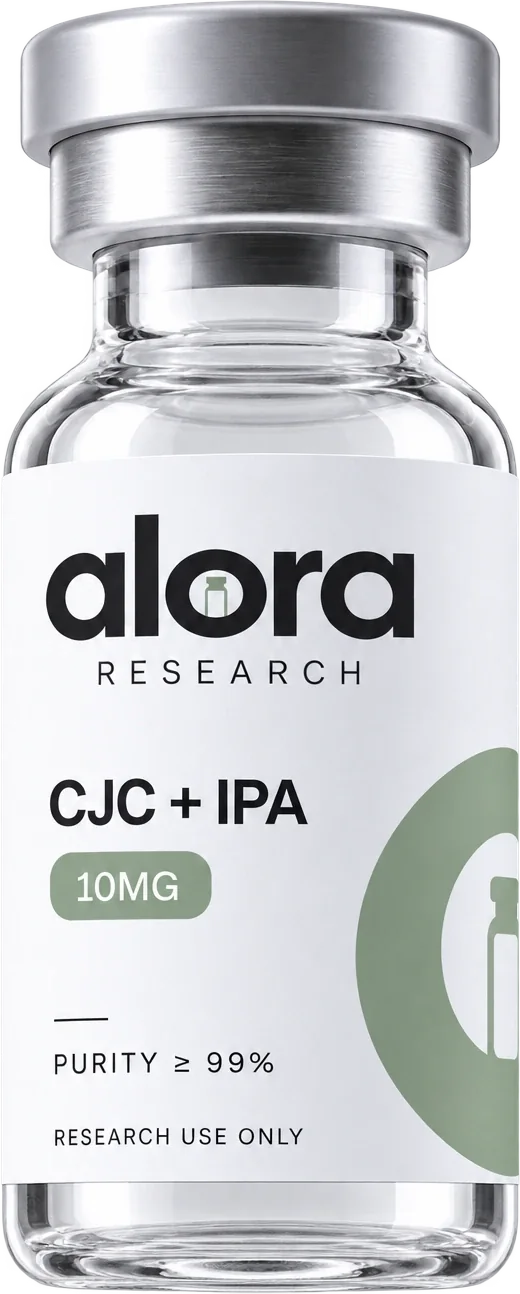
ALORA Research lists CJC-1295 + Ipamorelin as ALO-P-023. The catalog record does not specify component sequences, molecular formula or molecular weight. It therefore does not resolve the CJC-1295 chemical form by itself.
How do the receptor pathways differ?
Rat pituitary-cell investigations support different receptor pathways for the components, but do not demonstrate a combined receptor response for the exact pair. [1, 2]
The CJC-1295 discovery paper uses human GH-releasing factor (hGRF) terminology and describes activation of the GRF receptor in rat pituitary research. [1] Albumin-linked compounds were active in a GH secretion assay using cultured rat anterior pituitary cells. [1] A conjugate is a molecule chemically linked to another molecule.
In the ipamorelin investigation involving rat pituitary cells and animal models, pharmacological profiling used antagonists of GHRH and growth hormone-releasing peptides (GHRPs). [2] An antagonist blocks a receptor-mediated response. That investigation identified a GHRP-like receptor mechanism for ipamorelin. [2]
The ipamorelin abstract uses that receptor designation; it does not present a receptor structure or an exact-pair signaling map. [2] The CJC-1295 rat study reports GRF receptor activation, while the ipamorelin cell and animal study identifies a GHRP-like receptor mechanism. [1, 2] Neither abstract reports an exact-pair receptor response. [1, 2]
What do structure and “no DAC” terminology establish?
The rat discovery study describes albumin-reactive CJC-1295, while an analytical study lists CJC-1295 and CJC-1295 with drug affinity complex (DAC) separately. [1, 4]
The following distinctions keep chemical identity separate from the model used to investigate it.
| Material or designation | Structural or identity information | Experimental context |
|---|---|---|
| CJC-1295 in the discovery study | Modified hGRF(1-29) with an added reactive C-terminal lysine derivative | Cultured rat pituitary cells and rats. [1] |
| Ipamorelin | Aib-His-D-2-Nal-D-Phe-Lys-NH2 | Primary rat pituitary cells, rats and swine. [2] |
| CJC-1295 and CJC-1295 with DAC | Listed as separate analytical targets | In vitro metabolism and fortified urine. [4] |
| CJC-1295 plus ipamorelin | Exact combination discussed; component sequences not specified in the abstract | Narrative review of murine research. [3] |
In the CJC-1295 structural study, the reactive chemistry involved attachment to serum albumin at its free thiol on Cys34. [1] A thiol is a sulfur-containing chemical group. In rat plasma, a Western blot, a protein-detection method, identified a CJC-1295-reactive species at the albumin band. [1]
A separate analytical study used mass spectrometry and reference standards to identify glycine-modified analogs of ipamorelin and modified GRF 1-29. [5] Mass spectrometry characterizes molecules through measurements of ions; reference standards are characterized comparison materials.
These analytical abstracts do not establish a complete sequence-level definition of “CJC-1295 ipamorelin no DAC,” or prove that every such label is equivalent to modified GRF(1-29). [4, 5]
Why isn't there one half-life for the pair?
The human CJC-1295 investigation does not report pharmacokinetic measurements for CJC-1295 plus ipamorelin. [6]
Pharmacokinetics describes how a compound's measured concentration changes over time. Half-life is the time associated with a halving of concentration in the specified analysis.
The randomized, placebo-controlled human studies examined CJC-1295 rather than the exact pair. [6] Their abstract identifies the material as a long-acting GHRH analog but does not give a complete sequence. [6]
Raun et al.'s cell and animal pharmacology abstract does not report an ipamorelin elimination half-life or a combined-pair pharmacokinetic experiment. [2] Neither component investigation establishes a shared half-life for the pair. [2, 6]
Neither the human CJC-1295 study nor the ipamorelin cell and animal study reports pair-level pharmacokinetic measurements. [2, 6]
Which studies examine the exact pair?
Mayfield et al.'s narrative review describes CJC-1295 combined with ipamorelin in murine research, whereas the primary component papers investigate the compounds separately. [1, 2, 3]
The narrative review describes ‘murine models,’ without explicitly identifying the species in its abstract. [3] The review's abstract documents discussion of an exact-pair animal investigation, but does not provide its full methods, component sequences or quantitative single-component comparisons. [3]
The evidence falls into distinct categories:
- Exact pair: a narrative-review account of murine work, without a reported additivity analysis in the abstract. [3]
- CJC-1295 alone: cultured rat pituitary and rat pharmacokinetic investigations, alongside separate human pharmacokinetic research. [1, 6]
- Ipamorelin alone: primary rat pituitary-cell and animal pharmacology. [2]
- Other secretagogues: GHRP-6 was a comparator in ipamorelin experiments, not evidence for the CJC-1295–ipamorelin combination. [2]
The ipamorelin cell and animal abstract does not report a GHRH–GHRP combination experiment; antagonist profiling and comparisons among secretagogues address different questions. [2]
What do registered studies establish?
The component registry records list ipamorelin or CJC-1295 rather than the exact pair. [7, 8, 9]
NCT00672074 is a completed, randomized phase 2 study (see registry record) with quadruple masking, an industry sponsor and an ipamorelin–placebo comparison. [7] Masking describes which study participants or personnel are kept unaware of assigned groups.
NCT01280344 is also a completed, randomized phase 2 study (see registry record), with quadruple masking, an industry sponsor and a saline comparator. [8]
NCT00267527 is a terminated, randomized phase 2 study (see registry record) with double masking, an industry sponsor and a placebo-controlled design. [9]
Trial registration documents study design and status; it is not, by itself, a result. These component records do not describe a randomized comparison between the exact pair and its individual components. [7, 8, 9]
What would demonstrate synergy, and what documentation matters?
Synergy means a combined response exceeds an explicitly defined additive expectation, rather than merely differing from a control.
An additivity model defines the response expected when component effects are combined without an extra interaction.
Neither the component pharmacology abstracts nor the narrative review's murine summary reports that analysis for CJC-1295 plus ipamorelin. [1, 2, 3] The narrative review's murine summary leaves the quantitative interaction between the components unresolved. [3]
Chemical identity is a separate evidence question. The analytical literature used parent peptides and synthesized metabolites as reference materials in fortified urine, while another investigation compared unknown materials against reference standards. [4, 5] Those analytical investigations address molecular identification, not exact-pair receptor synergy. [4, 5]
For lot-specific documentation, see the COA library and How to read a Certificate of Analysis. COA means certificate of analysis. Documentation of material identity and evidence of a biological interaction answer different research questions.
What the research establishes / What it does not establish
What the research establishes
- The rat discovery investigation describes CJC-1295 as a modified hGRF(1-29) structure with an added reactive terminal group and reports albumin-associated detection in rat plasma. [1]
- The ipamorelin cell and animal investigation reports its sequence and supports a GHRP-like receptor mechanism through antagonist profiling. [2]
- A narrative review describes CJC-1295 plus ipamorelin research in murine models. [3]
- An analytical investigation lists CJC-1295 and CJC-1295 with drug affinity complex as separate targets. [4]
- Randomized, placebo-controlled human studies examined CJC-1295 rather than CJC-1295 plus ipamorelin. [6]
What it does not establish
- A quantitative synergy analysis for the exact pair is not reported in the narrative review's murine-study summary. [3]
- A complete sequence-level definition of “CJC-1295 no DAC,” or its equivalence to modified GRF(1-29), is not established by the analytical abstracts. [4, 5]
- A combined-pair half-life is not reported in the cited component studies involving cells, animals and humans. [1, 2, 6]
- A randomized study of the exact pair is not identified by the intervention lists in the component registry records. [7, 8, 9]
Evidence at a glance
| Study | Year | Model | What was reported | Source |
|---|---|---|---|---|
| Jetté et al. | 2005 | Animal model | In rat plasma, Western blot analysis detected a CJC-1295-reactive species at the serum albumin band, supporting the reported albumin-associated molecular form. [1] | [1] |
| Raun et al. | 1998 | Cell / in vitro | In primary rat pituitary cells, ipamorelin released GH with potency and efficacy similar to GHRP-6. [2] | [2] |
| Mayfield et al. | 2026 | Review | A narrative review describes exact-pair CJC-1295–ipamorelin research in murine models without reporting an additivity analysis in its abstract. [3] | [3] |
| Memdouh et al. | 2021 | Analytical chemistry | An analytical investigation of in vitro metabolism and fortified urine listed CJC-1295 and CJC-1295 with drug affinity complex as separate targets. [4] | [4] |
| Teichman et al. | 2006 | Human study | Randomized, placebo-controlled human studies examined CJC-1295 separately; their abstract does not report an exact-pair pharmacokinetic investigation. [6] | [6] |
| Ipamorelin registry NCT00672074 | 2008 | Trial registry | The registry describes a completed, randomized phase 2 study with quadruple masking, an industry sponsor and an ipamorelin–placebo comparison. [7] | [7] |
| Ipamorelin registry NCT01280344 | 2011 | Trial registry | The registry describes a completed, randomized phase 2 study with quadruple masking, an industry sponsor and a saline comparator. [8] | [8] |
| CJC-1295 registry NCT00267527 | 2005 | Trial registry | The registry describes a terminated, randomized phase 2 study with double masking, an industry sponsor and a placebo-controlled design. [9] | [9] |
Frequently asked questions
What is CJC-1295 ipamorelin?
The name refers to a pairing of a growth hormone-releasing hormone analog and a growth hormone secretagogue receptor agonist, supported by separate component investigations in rat-cell and animal models. [1, 2] A narrative review also describes research on the exact pair in murine models, but its abstract does not establish receptor-level synergy. [3]
Is CJC-1295 the same as ipamorelin?
No: the rat discovery study describes CJC-1295 as a modified human growth hormone-releasing factor structure with an added reactive terminal group. [1] The ipamorelin cell and animal paper reports the distinct sequence Aib-His-D-2-Nal-D-Phe-Lys-NH2 and a GHRP-like receptor mechanism. [2]
What does no DAC mean in CJC-1295 ipamorelin?
An analytical study distinguishes CJC-1295 from CJC-1295 with drug affinity complex, abbreviated DAC, but its abstract does not provide a complete sequence-level definition of “no DAC.” [4] The rat discovery study describes an albumin-reactive CJC-1295 structure. [1] Those abstracts do not establish that material labeled “no DAC” has the same molecular identity as the compound in the rat discovery study. [1, 4]
What research examines CJC-1295 and ipamorelin together?
Mayfield et al.'s narrative review describes the exact combination in murine research. [3] Its abstract does not provide the original investigation's complete methods, component sequences or quantitative single-component comparisons. [3] The component registry records discussed here list ipamorelin or CJC-1295, rather than the exact pair. [7, 8, 9]
Why isn't there one half-life for CJC-1295 ipamorelin?
The cited randomized human investigation examines CJC-1295 rather than the exact pair. [6] The ipamorelin cell and animal pharmacology abstract does not report an elimination half-life. [2] These component investigations therefore do not establish a shared half-life for the pair. [2, 6]
What evidence would demonstrate synergy between the pathways?
Synergy means a combined response exceeds an explicitly defined additive expectation. The narrative review's murine summary does not report that analysis for CJC-1295 plus ipamorelin. [3]
References
- 1.Jetté L, Léger R, Thibaudeau K, et al. Human growth hormone-releasing factor (hGRF)1-29-albumin bioconjugates activate the GRF receptor on the anterior pituitary in rats: identification of CJC-1295 as a long-lasting GRF analog Endocrinology. 2005. PMID 15817669
- 2.Raun K, Hansen BS, Johansen NL, et al. Ipamorelin, the first selective growth hormone secretagogue European journal of endocrinology. 1998. PMID 9849822
- 3.Mayfield CK, Bolia IK, Feingold CL, et al. Injectable Peptide Therapy: A Primer for Orthopaedic and Sports Medicine Physicians The American journal of sports medicine. 2026. PMID 41476424
- 4.Memdouh S, Gavrilović I, Ng K, et al. Advances in the detection of growth hormone releasing hormone synthetic analogs Drug testing and analysis. 2021. PMID 34665524
- 5.Gajda PM, Holm NB, Hoej LJ, et al. Glycine-modified growth hormone secretagogues identified in seized doping material Drug testing and analysis. 2019. PMID 30136411
- 6.Teichman SL, Neale A, Lawrence B, et al. Prolonged stimulation of growth hormone (GH) and insulin-like growth factor I secretion by CJC-1295, a long-acting analog of GH-releasing hormone, in healthy adults The Journal of clinical endocrinology and metabolism. 2006. PMID 16352683
- 7.Safety and Efficacy of Ipamorelin for Management of Post-Operative Ileus ClinicalTrials.gov. 2008. NCT00672074
- 8.Safety and Efficacy of Ipamorelin Compared to Placebo for the Recovery of Gastrointestinal Function ClinicalTrials.gov. 2011. NCT01280344
- 9.A Study to Evaluate CJC 1295 in HIV Patients With Visceral Obesity ClinicalTrials.gov. 2005. NCT00267527