GHK-Cu peptide research: Copper, genes and matrix evidence
A source-linked guide to copper binding, gene-expression claims and matrix experiments, distinguishing GHK from its copper complex and derivatives.
ALORA Research editorial teamPublished Last reviewed 8 min read
The short answer
GHK-Cu peptide research examines glycyl-L-histidyl-L-lysine complexed with copper(II), focusing on chemical identity and experimental cellular responses. Reviews summarize gene-expression and matrix findings, while primary cell and mouse studies examine particular molecular pathways. The key distinction is between findings attributed to GHK and experiments explicitly using GHK-Cu; the published abstracts do not establish a single mechanism connecting all reported observations.
Key facts
- Chemical identity
- Glycyl-L-histidyl-L-lysine copper(II) complex [1]
- Identity distinction
- GHK-Cu and Pal-GHK are distinct derivatives [2]
- Gene-expression evidence
- Review-level claims described under GHK [3]
- Primary matrix model
- Collagen deposition measured in bleomycin-exposed mice [4]
- Human research status
- Registered phase 2 study; record lists RECRUITING [5]
- Catalog code
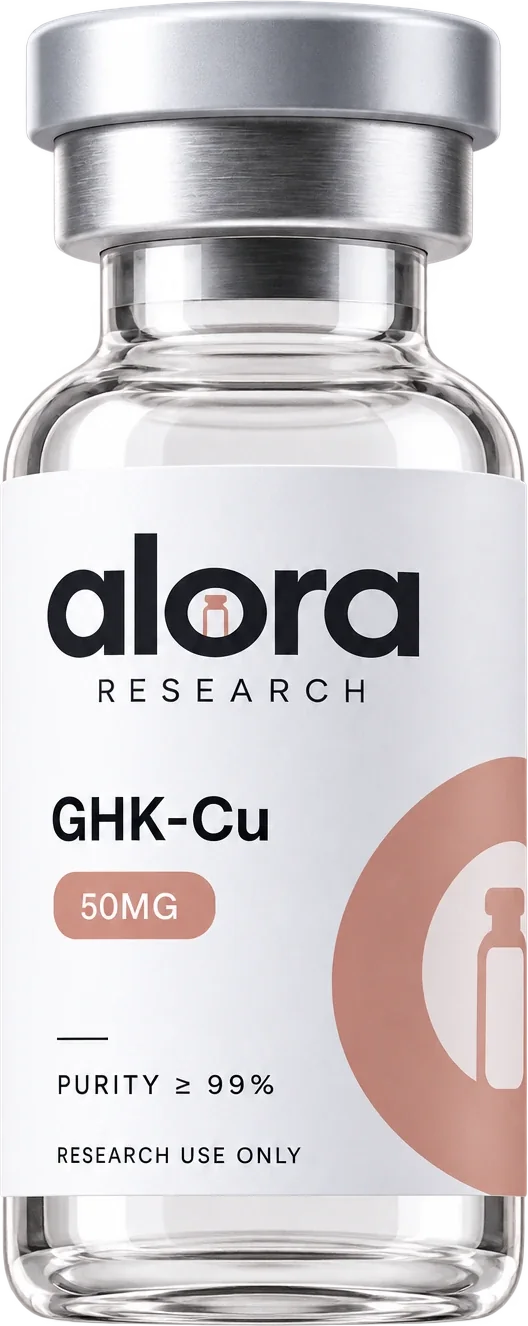
- ALO-P-020
- Molecular formula
- C14H24N6O4·Cu
- Molecular weight
- 401.9 g/mol
- Sequence
- GHK
- Classification
- Research peptide — laboratory use only
What does GHK-Cu peptide research study?
GHK-Cu peptide research examines the copper complex of glycyl-L-histidyl-L-lysine, with reviews connecting its chemical identity to cellular and extracellular-matrix experiments. [1, 3] A peptide is an amino-acid chain; a metal complex associates a metal ion with molecules that bind it.
The chemical names need to remain separate. The chemistry review identifies GHK as the parent peptide and GHK-Cu as its copper(II) complex. [1] Copper(II) identifies the oxidation state of the copper. Apo denotes a form without its bound metal.
A review of GHK derivatives distinguishes GHK-Cu, the metal complex, from Pal-GHK, the palmitoylated derivative. [2] Palmitoylation means attaching a palmitoyl group, a lipid-related chemical group. These names therefore should not be regarded as interchangeable labels for the same research material. [1, 2]
This distinction matters when reading the gene-expression literature: the gene-regulation claim in the review abstract is attributed to GHK, rather than to an explicitly described experiment using a preformed copper complex. [3]
How does GHK-Cu bind copper?
The chemistry review reports that GHK binds copper(II), with affinity similar to the copper transport site on albumin, and forms GHK-Cu. [1] Affinity describes the tendency of interacting molecules or ions to remain associated. Coordination describes bonding between a metal ion and atoms that supply electron density to it.
A simple identity schematic is: GHK — binds copper(II) → GHK-Cu. [1] This schematic identifies the participants; it does not locate the coordinating atoms or depict a measured molecular geometry.
The review abstract does not provide coordinating-atom assignments, numerical binding constants or conditions defining which copper-containing species predominate. [1] Speciation means the distribution of chemical forms under particular conditions.
Consequently, the review supports the chemical distinction between GHK and its copper complex, but its abstract cannot support an atom-by-atom coordination drawing. [1] A diagram showing specific bonds would require structural evidence beyond the description given in that abstract. [1]
What do GHK-Cu gene-expression studies actually measure?
The gene-expression reviews describe broad regulation under the name GHK, but their abstracts do not provide enough experimental provenance to reconstruct a specific GHK-Cu transcriptomic experiment. [3, 6] Gene expression concerns the production of gene-derived molecules. A transcript is a ribonucleic acid (RNA) copy made from a gene; a gene-expression signature is a pattern of transcript measurements.
The review by Pickart and colleagues states that GHK can increase or decrease expression of at least 4,000 human genes. [3] That is a review-level claim, and its abstract does not identify the underlying cell types, dataset or analysis method. [3] The review by Pickart and Margolina also connects genetic data to biochemical pathways while describing GHK in its abstract. [6]
| Review | Molecule named in the abstract | Dataset and cell model | Analysis and validation |
|---|---|---|---|
| Pickart and colleagues [3] | GHK [3] | Not specified in the abstract [3] | Methods and independent validation not specified [3] |
| Pickart and Margolina [6] | GHK [6] | Not specified in the abstract [6] | Methods and independent validation not specified [6] |
An expression signature and a causal mechanism answer different questions. The former describes a pattern; the latter explains how a change occurs. These review abstracts do not establish a fully specified chain from copper coordination to a particular expression signature and then to a demonstrated molecular mechanism. [3, 6]
What have studies measured in fibroblasts and the extracellular matrix?
Reviews describe fibroblast-related experiments and matrix synthesis, while a primary mouse study measures collagen deposition, matrix-associated proteins and signaling. [1, 3, 4] Fibroblasts are connective-tissue cells involved in producing the extracellular matrix, the material surrounding cells. Collagen is a structural matrix protein.
In its synthesis of GHK research, the review by Pickart and colleagues describes both synthesis and breakdown of collagen and glycosaminoglycans, together with modulation of metalloproteinases and their inhibitors. [3] Glycosaminoglycans are long sugar-chain molecules; metalloproteinases are metal-dependent enzymes that break down proteins. The chemistry and matrix review also summarizes collagen-related protein synthesis and fibroblast proliferation. [1]
These review abstracts do not identify a cell-specific collagen experiment with culture conditions and detailed comparator information. [1, 3] They therefore provide a map of reported research topics rather than a complete account of a primary fibroblast experiment. [1, 3]
In bleomycin-exposed mice, Ma and colleagues measured collagen deposition, fibronectin expression and matrix-enzyme/inhibitor balance in lung tissue. [4] It also used immunoblotting, a method for detecting proteins, to examine signaling pathways. [4]
The mouse findings and the review descriptions concern different models and endpoints; together they do not support a blanket claim that GHK-Cu always increases collagen. [1, 3, 4]
What is known about the GHK-Cu mechanism of action?
Primary studies identify candidate protein targets in defined cell and mouse systems, rather than establishing a single mechanism across all GHK-Cu experiments. [7, 8]
Bian and colleagues paired a silica-exposed mouse model with experiments using RAW264.7 macrophages, a cultured immune-cell model. [7] They identified peroxiredoxin 6 (PRDX6) as a molecular target and reported that GHK-Cu can bind it. [7] The authors linked their findings partly to reduced oxidative stress in macrophages. [7] Oxidative stress describes an imbalance involving oxidizing species and cellular defenses.
Deng and colleagues examined GHK-Cu in C2C12 myotubes, cultured muscle cells, and smoke-exposed mice. [8] Within those experimental systems, the authors reported binding and activation of sirtuin 1 (SIRT1), alongside changes in protein regulation and mitochondrial markers. [8]
Protein binding, altered protein activity and a gene-expression signature are distinct evidence categories. The PRDX6 and SIRT1 study abstracts do not demonstrate that either target explains the fibroblast findings or the broad expression claims summarized in the reviews. [1, 3, 6, 7, 8] Their mechanistic conclusions should remain attached to the experimental systems in which they were reported. [7, 8]
How do researchers separate GHK-Cu from GHK or copper alone?
The cited primary-study abstracts do not describe a complete comparison of GHK-Cu, unbound GHK, copper alone and an altered peptide sequence. [4, 7, 8]
These comparator names describe different experimental questions. A metal-free peptide comparator concerns the peptide without prebound metal. A copper-only comparator concerns copper without the peptide. A sequence control changes the peptide sequence. When reading an abstract, distinguish an explicitly reported comparison from one that would merely be informative.
A narrower comparison appears in the work by Wang and colleagues: encapsulated GHK-Cu was compared with free GHK-Cu in a mouse scald model. [9] The carrier was a liposome, a vesicle enclosed by a lipid membrane. In cultured human umbilical vein endothelial cells, the same study examined cell proliferation and growth-factor protein expression with liposome-encapsulated GHK-Cu. [9]
That study addresses carrier formulation, but its abstract does not describe a complete separation of copper-dependent, peptide-dependent and sequence-dependent contributions. [9]
An abstract that omits a comparator does not prove that the full paper omitted it; the distinction is between unreported detail and a documented experimental absence.
What is still unknown, and what does lot documentation add?
The published abstracts leave coordination detail, gene-expression provenance and cross-model mechanistic links unresolved, while the registry record describes an ongoing study rather than a demonstrated mechanism. [1, 3, 5, 6, 7, 8]
A registered phase 2 study lists randomized allocation, a vehicle comparator, industry sponsorship and recruiting status. [5] A vehicle comparator is the comparison material without the compound under investigation. The registry's official title describes double-blind design, while its structured masking field lists quadruple masking. [5] Those fields should be read separately rather than silently reconciled.
For catalog identity, consult the GHK-Cu catalog record. For lot-specific records, consult the certificate of analysis library, with How to read a Certificate of Analysis as a documentation guide.
Keep material documentation separate from biological interpretation. A catalog identity or lot document should not be read as experimental evidence for a protein target. For mechanistic interpretation, retain the chemical species, model and endpoint alongside each reported finding.
What the research establishes / What it does not establish
What the research establishes
- The chemistry review identifies GHK-Cu as the copper(II) complex of glycyl-L-histidyl-L-lysine and reports copper affinity similar to the copper transport site on albumin. [1]
- The derivative review distinguishes the GHK-Cu metal complex from the palmitoylated derivative Pal-GHK. [2]
- The gene-expression reviews attribute broad gene regulation to GHK, while leaving the underlying datasets and cell models unspecified in their abstracts. [3, 6]
- In bleomycin-exposed mice, a primary GHK-Cu study measured collagen deposition, matrix-associated proteins and protein signaling. [4]
- Studies using macrophage and myotube models alongside mouse experiments report PRDX6 and SIRT1, respectively, as molecular targets associated with GHK-Cu. [7, 8]
What it does not establish
- The chemistry review abstract does not establish the coordinating atoms, atomic geometry or numerical binding constants of GHK-Cu. [1]
- The gene-expression review abstracts do not identify the underlying datasets, cell types, analysis methods or independent validation needed to trace their claims to fully specified experiments. [3, 6]
- The cited primary-study abstracts do not describe a complete chemical-species comparison involving GHK-Cu, unbound GHK, copper alone and an altered peptide sequence. [4, 7, 8]
- The macrophage, myotube and mouse studies do not establish in their abstracts that peroxiredoxin 6 or sirtuin 1 explains the fibroblast and matrix findings summarized in the reviews. [1, 3, 7, 8]
- The recruiting phase 2 registry record establishes a study design and status, not a demonstrated molecular mechanism. [5]
Evidence at a glance
| Study | Year | Model | What was reported | Source |
|---|---|---|---|---|
| Pickart: copper binding and matrix research | 2008 | Review | The review describes GHK binding copper(II) to form GHK-Cu and summarizes matrix-protein synthesis and fibroblast-related findings. [1] | [1] |
| Pickart et al.: gene-expression review | 2015 | Review | The review attributes broad human gene regulation to GHK, without identifying the underlying datasets or cell models in its abstract. [3] | [3] |
| Ma et al. | 2020 | Animal model | In bleomycin-exposed mice, the study measured collagen deposition, matrix-enzyme/inhibitor balance and signaling proteins. [4] | [4] |
| Registered GHK-Cu study | 2026 | Trial registry | The registry lists a recruiting phase 2 study with randomized allocation, a vehicle comparator and industry sponsorship. [5] | [5] |
| Bian et al.: cell experiments | 2024 | Cell / in vitro | In RAW264.7 macrophages, the study examined GHK-Cu and oxidative-stress responses to crystalline silica. [7] | [7] |
| Deng et al.: cell experiments | 2023 | Cell / in vitro | In C2C12 myotubes, the study reported changes in protein expression, mitochondrial content and oxidative-stress responses with GHK-Cu. [8] | [8] |
| Wang et al. | 2017 | Cell / in vitro | In cultured human umbilical vein endothelial cells, liposome-encapsulated GHK-Cu increased cell proliferation and growth-factor protein expression. [9] | [9] |
Frequently asked questions
What is GHK-Cu peptide, and how is it different from GHK?
GHK is glycyl-L-histidyl-L-lysine; GHK-Cu is its copper(II) complex, as described in the chemistry review. [1] A separate review distinguishes GHK-Cu from Pal-GHK, a chemically modified derivative rather than the copper complex. [2]
How does GHK-Cu bind copper?
The chemistry review reports that GHK binds copper(II), with affinity similar to the copper transport site on albumin, and forms GHK-Cu. [1] Its abstract does not specify the coordinating atoms, atomic geometry or numerical binding constants, so it cannot support a detailed coordination diagram. [1]
What do GHK-Cu gene-expression studies actually measure?
Gene-expression measurements describe how strongly genes are expressed, often through the abundance of their RNA transcripts. The cited reviews discuss gene regulation under the name GHK, but their abstracts do not identify the underlying datasets, cell types or independent validation. [3, 6] Those abstracts therefore do not establish a fully specified GHK-Cu experiment linking an expression signature to a causal molecular mechanism. [3, 6]
What have GHK-Cu studies measured in fibroblasts and the extracellular matrix?
Reviews describe fibroblast-related experiments and changes in collagen, other matrix components and matrix-regulating enzymes, but their abstracts do not provide a cell-specific collagen experiment with detailed comparators. [1, 3] In bleomycin-exposed mice, a primary GHK-Cu study measured collagen deposition, fibronectin expression and signaling proteins. [4] These are different experimental contexts and should not be summarized as a universal increase in collagen. [1, 3, 4]
Is the GHK-Cu mechanism of action established?
These abstracts do not establish a single GHK-Cu mechanism connecting the reported fibroblast, gene-expression and target-binding findings. [3, 6, 7, 8] A study combining RAW264.7 macrophages and silica-exposed mice identified peroxiredoxin 6 as a molecular target and reported GHK-Cu binding. [7] Another study using C2C12 myotubes and smoke-exposed mice reported binding and activation of sirtuin 1. [8] Neither abstract establishes that its proposed target explains the fibroblast or gene-expression findings summarized in the reviews. [3, 6, 7, 8]
Do published experiments separate GHK-Cu from GHK or copper alone?
The cited primary-study abstracts do not describe a complete comparison including GHK-Cu, unbound GHK, copper alone and an altered peptide sequence. [4, 7, 8] A liposome study explicitly compares encapsulated and free GHK-Cu in a mouse model, but that comparison concerns formulation rather than separation of peptide and copper contributions. [9] Missing information in an abstract should not be interpreted as proof that a comparison was absent from the full paper.
References
- 1.Pickart L The human tri-peptide GHK and tissue remodeling Journal of biomaterials science. Polymer edition. 2008. PMID 18644225
- 2.Mortazavi SM, Mohammadi Vadoud SA, Moghimi HR Topically applied GHK as an anti-wrinkle peptide: Advantages, problems and prospective BioImpacts : BI. 2025. PMID 39963574
- 3.Pickart L, Vasquez-Soltero JM, Margolina A GHK Peptide as a Natural Modulator of Multiple Cellular Pathways in Skin Regeneration BioMed research international. 2015. PMID 26236730
- 4.Ma WH, Li M, Ma HF, et al. Protective effects of GHK-Cu in bleomycin-induced pulmonary fibrosis via anti-oxidative stress and anti-inflammation pathways Life sciences. 2020. PMID 31809714
- 5.Topical GHK-Cu Gel for Acute Skin Wound Healing ClinicalTrials.gov. 2026. NCT07437586
- 6.Pickart L, Margolina A Regenerative and Protective Actions of the GHK-Cu Peptide in the Light of the New Gene Data International journal of molecular sciences. 2018. PMID 29986520
- 7.Bian Y, Deng M, Liu J, et al. The glycyl-l-histidyl-l-lysine-Cu2+ tripeptide complex attenuates lung inflammation and fibrosis in silicosis by targeting peroxiredoxin 6 Redox biology. 2024. PMID 38879894
- 8.Deng M, Zhang Q, Yan L, et al. Glycyl-l-histidyl-l-lysine-Cu2+ rescues cigarette smoking-induced skeletal muscle dysfunction via a sirtuin 1-dependent pathway Journal of cachexia, sarcopenia and muscle. 2023. PMID 36905132
- 9.Wang X, Liu B, Xu Q, et al. GHK-Cu-liposomes accelerate scald wound healing in mice by promoting cell proliferation and angiogenesis Wound repair and regeneration : official publication of the Wound Healing Society [and] the European Tissue Repair Society. 2017. PMID 28370978