Tesamorelin peptide: structure, mechanism and research evidence
Explore tesamorelin's GHRH classification, analytical studies, publication types, and limits of the published structural and receptor evidence.
ALORA Research editorial teamPublished Last reviewed 6 min read
The short answer
Tesamorelin peptide is a synthetic analog of human growth hormone-releasing hormone (GHRH), also called growth hormone-releasing factor. It appears in the literature as TH9507 and GHRH(1-44). Its published record includes human studies and laboratory detection research. The cited review and analytical abstracts do not establish detailed modification chemistry, direct receptor-binding measurements, or enzyme-specific stability.
Key facts
- Class
- Synthetic GHRH analog, described in a pharmacology review. [1]
- Published notation
- GHRH(1-44), in a pooled human analysis. [2]
- Research name
- TH9507, explicitly paired with tesamorelin in the human report. [2]
- Analytical model
- Laboratory metabolism and fortified urine—urine with added reference material. [3]
- Receptor-evidence limit
- No direct binding measurements in the cited pharmacology review's abstract. [1]
- Catalog code
- ALO-P-012
- Molecular weight
- 5135.9 g/mol
- Classification
- Research peptide — laboratory use only
What is tesamorelin peptide?
Tesamorelin peptide is described in a pharmacology review as a synthetic analog of human growth hormone-releasing hormone (GHRH). [1]
An analog is a compound structurally related to another compound. The review also identifies growth hormone-releasing factor as another name for GHRH. [1] Falutz and colleagues explicitly pair the research name TH9507 with tesamorelin in the title of their pooled human-study publication. [2] That human report also uses the notation GHRH(1-44). [2]
These names provide an identity reference, but they should not be mistaken for a complete chemical specification. Read the research record in separate layers: molecular identity, pharmacological description, direct experimental methods, and human study design. A research name, a review, and a human study answer different questions.
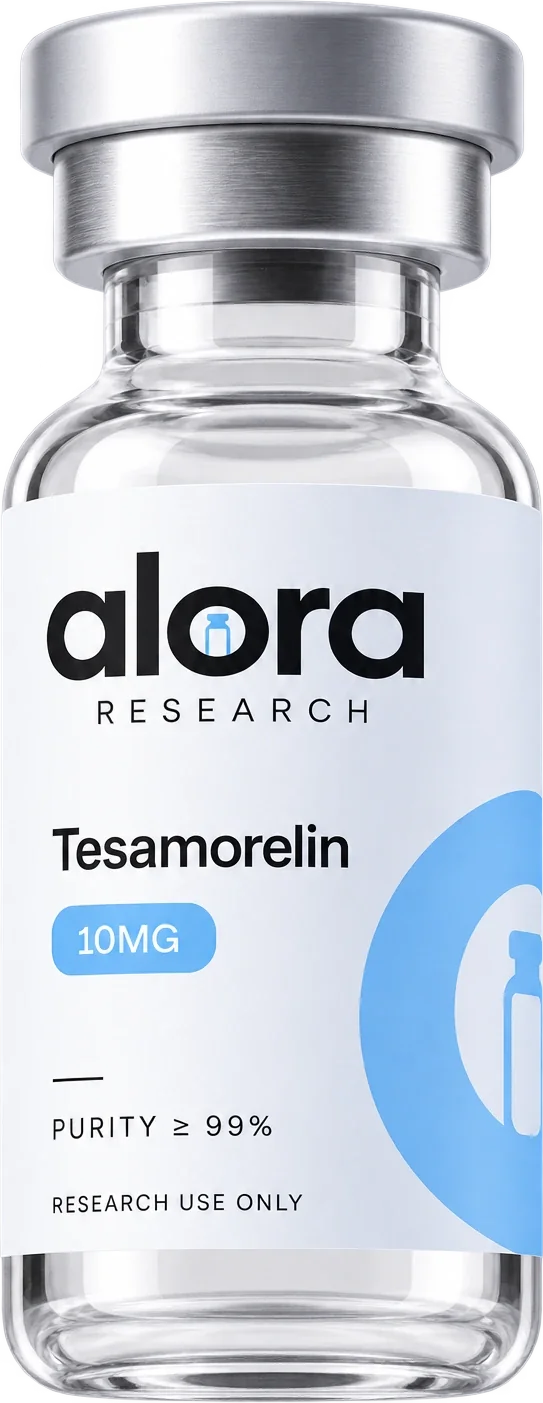
For the catalog identity reference, consult the Tesamorelin catalog record.
What does the literature establish about its structure?
The pooled human report supplies the notation GHRH(1-44), not a complete sequence-and-modification description. [2]
An amino-acid sequence specifies the linear arrangement of amino-acid units in a peptide. N-terminal means the amino end of that chain. N-terminal acylation means attaching an acyl group at that end; it is chemically distinct from replacing an amino-acid unit within the sequence.
Neither the pooled human-study abstract nor the pharmacology review's abstract prints a complete sequence or specifies an N-terminal chemical group. [1, 2] A diagram assigning the precise modification would therefore require a direct structural reference rather than reconstruction from the notation used in the human-study abstract.
The same abstracts do not distinguish the free peptide from a particular salt form or provide a chemical-identifier crosswalk. [1, 2] For structural comparisons, keep the residue sequence, attached chemical groups, and salt form in separate fields. Do not fill a missing field by assuming that a familiar research name specifies every chemical detail.
What is tesamorelin's mechanism of action?
The cited pharmacology review classifies tesamorelin as a synthetic GHRH analog but does not report direct receptor-assay measurements in its abstract. [1]
That is a review-level classification. It is not the same as a quantitative experimental profile at the growth hormone-releasing hormone receptor (GHRHR). Receptor-binding assays measure interaction with a receptor; functional assays measure a response associated with receptor activity.
The review's abstract does not report binding affinity, receptor selectivity, functional potency, or a receptor-expression model used to examine tesamorelin. [1] It also does not describe an intracellular signaling pathway demonstrated specifically with tesamorelin. [1]
Neither the pooled human analysis nor the analytical urine study reports direct GHRHR-binding experiments in its abstract. [2, 3] Human study design and peptide detection should therefore not be presented as receptor-level confirmation.
When evaluating a mechanistic explanation, separate experiments using tesamorelin from explanations based on native GHRH. A review-level description can identify the proposed pharmacological relationship without supplying every experiment needed to establish its molecular details.
Which studies examine metabolism and analytical detection?
Memdouh and colleagues directly investigated laboratory metabolism and analytical detection in a peptide panel that included tesamorelin and sermorelin. [3]
In vitro means work performed outside a living organism. Fortified urine is urine to which reference material has been added. The analytical study investigated in vitro metabolism and identified major metabolites across its peptide panel. [3]
The study developed a liquid chromatography–tandem mass spectrometry detection method in fortified urine. [3] Liquid chromatography separates components of a sample; tandem mass spectrometry characterizes selected ions and their fragments.
The analytical abstract reports findings across the panel rather than assigning every metabolite and detection characteristic specifically to tesamorelin. [3] It does not identify a specific enzyme responsible for tesamorelin cleavage or quantify protection conferred by an N-terminal modification. [3]
The inclusion of sermorelin supports a shared analytical context, but the abstract does not provide a direct sequence comparison or receptor-binding comparison between sermorelin and tesamorelin. [3] Keep analytical detectability, molecular structure, and receptor activity as separate comparison questions.
How should the published study record be counted?
Publication count is not the same as independent-cohort count: the human literature includes pooled and secondary analyses. [2, 4, 5]
A cohort is a group of study participants. A pooled analysis combines data from studies; a secondary analysis examines an existing dataset for an additional question. A review synthesizes publications rather than recruiting another study group.
| Publication | Evidence category | What the abstract establishes about the study unit |
|---|---|---|
| Falutz and colleagues | Pooled human analysis | Combines two multicenter, double-blind, placebo-controlled phase 3 studies. [2] |
| Lake and colleagues | Secondary human analysis | Selects participants from two completed placebo-controlled randomized trials. [4] |
| Russo and colleagues | Human subgroup analysis | Uses an existing randomized double-blind trial of 61 participants. [5] |
| Ellis and colleagues | Human study report | Describes a 6-month phase 2 randomized open-label study. [6] |
| Spooner and Olin | Review of human studies | Discusses phase 3 trials and their pooled analyses. [7] |
| Memdouh and colleagues | Analytical validation study | Examines laboratory metabolism and peptide detection in fortified urine. [3] |
Lake explicitly reuses participants from completed human trials, while Russo explicitly analyzes an existing human trial. [4, 5] Their abstracts do not provide enough identifying information to link every publication to every underlying cohort. [4, 5] A fully deduplicated map would require explicit parent-study identifiers and publication links.
The Ellis human study uses an open-label design, whereas the studies pooled by Falutz are described as double-blind. [2, 6] Open-label means study assignments are not masked. These design labels should remain attached to the individual reports rather than being generalized across the entire literature.
Spooner and Olin's human-study review discusses both trials and pooled analyses, illustrating why review citations should not be counted as additional independent experiments. [7]
What do registry records and lot documents add?
Registry records add study-design and status information, including a completed registered phase 3 study under the name TH9507. [8]
NCT00123253 describes an industry-sponsored, randomized, double-blind, placebo-controlled registered phase 3 study (see registry record). [8] Its intervention field uses TH9507, while the pooled human publication explicitly links that name to tesamorelin. [2, 8]
NCT00850564 describes a completed human study led by Massachusetts General Hospital, with no masking and phase listed as not applicable. [9] NCT02196831 also lists Massachusetts General Hospital as lead sponsor and describes a completed randomized, quadruple-masked human study with a placebo comparator. [10]
Russo's human analysis and NCT02196831 both describe a randomized study with 61 participants, but the publication abstract does not print the registry identifier. [5, 10] Matching enrollment alone should not be regarded as definitive evidence that records describe the same cohort.
Keep study documentation separate from material documentation. For lot-specific records, consult the certificate of analysis (COA) library. For document-reading guidance, see How to read a Certificate of Analysis.
A registry documents a study; a lot record documents a material. Neither should substitute for direct structural characterization or receptor experiments when those are the questions being asked.
What the research establishes / What it does not establish
What the research establishes
- A pharmacology review describes tesamorelin as a synthetic analog of human GHRH. [1]
- The pooled human-study publication explicitly identifies tesamorelin as TH9507 and uses the notation GHRH(1-44). [2]
- An analytical study includes tesamorelin in laboratory metabolism research and a peptide-detection method using fortified urine. [3]
- The published human record includes a pooled analysis and secondary analyses of existing trial participants. [2, 4, 5]
- The TH9507 registry describes a completed, industry-sponsored, randomized, double-blind, placebo-controlled phase 3 study. [8]
What it does not establish
- A complete sequence-and-modification description is not established by the cited pharmacology review and pooled human-study abstracts. [1, 2]
- Direct receptor-binding affinity, receptor selectivity, and functional potency are not reported in the cited pharmacology review's abstract. [1]
- An enzyme-specific explanation of tesamorelin cleavage or protection from an N-terminal modification is not reported in the analytical study's abstract. [3]
- A complete independent-cohort count cannot be reconstructed from the pooled and secondary human-study abstracts without explicit links between their underlying studies. [2, 4, 5]
- The cited pharmacology review and pooled human-study abstracts do not resolve salt forms or provide a chemical-identifier crosswalk. [1, 2]
Evidence at a glance
| Study | Year | Model | What was reported | Source |
|---|---|---|---|---|
| Dhillon | 2011 | Review | A pharmacology review describes tesamorelin as a synthetic analog of human GHRH. [1] | [1] |
| Falutz et al. | 2010 | Human study | The human publication pools two multicenter, double-blind, placebo-controlled phase 3 studies and explicitly identifies tesamorelin as TH9507. [2] | [2] |
| Memdouh et al. | 2021 | Analytical chemistry | In an analytical study of laboratory metabolism and fortified urine, tesamorelin was included in a peptide panel used to develop a liquid chromatography–tandem mass spectrometry detection method. [3] | [3] |
| Lake et al. | 2021 | Human study | The secondary human analysis selected participants from two completed placebo-controlled randomized trials rather than describing a newly recruited cohort. [4] | [4] |
| Russo et al. | 2024 | Human study | The human subgroup analysis used an existing randomized double-blind trial of 61 participants rather than reporting a separately recruited trial. [5] | [5] |
| Ellis et al. | 2025 | Human study | The human study report describes a 6-month phase 2 randomized open-label study. [6] | [6] |
| TH9507 registry record | 2005 | Trial registry | The registry describes a completed, industry-sponsored, randomized, double-blind, placebo-controlled phase 3 human study under the name TH9507. [8] | [8] |
| Short-term GHRH registry record | 2009 | Trial registry | The registry describes a completed human study led by Massachusetts General Hospital, with no masking and phase listed as not applicable. [9] | [9] |
Frequently asked questions
What is tesamorelin peptide?
A pharmacology review describes tesamorelin as a synthetic analog of human growth hormone-releasing hormone (GHRH), also called growth hormone-releasing factor. [1] A pooled human-study report identifies it as tesamorelin (TH9507) and uses the notation GHRH(1-44). [2]
Is TH9507 the same compound as tesamorelin?
Yes: the pooled human-study publication explicitly pairs tesamorelin with TH9507 in its title. [2] TH9507 also appears as the intervention name in a completed registered phase 3 study (see registry record). [8]
What is tesamorelin's mechanism of action?
A pharmacology review classifies tesamorelin as a synthetic GHRH analog. [1] That review's abstract does not report direct receptor-binding measurements, receptor selectivity, or functional potency measurements. [1] The broad pharmacological description therefore needs to be distinguished from a quantitative receptor-assay profile.
What does the published literature establish about tesamorelin's structure?
The pooled human-study abstract identifies tesamorelin using GHRH(1-44). [2] Neither that abstract nor the cited pharmacology review's abstract provides a complete amino-acid sequence or specifies the N-terminal modification. [1, 2] They therefore do not support a complete sequence-and-modification diagram.
Which published study directly examines tesamorelin's enzymatic stability?
Memdouh and colleagues investigated laboratory metabolism and analytical detection in a panel that included tesamorelin. [3] Their analytical abstract describes metabolite reference materials and peptide detection in fortified urine, but does not identify a tesamorelin-specific cleavage enzyme or quantify protection from an N-terminal modification. [3] It should not be presented as a direct enzyme-specific stability measurement.
How does tesamorelin compare with sermorelin at the molecular level?
The analytical study includes tesamorelin and sermorelin in the same laboratory metabolism and detection panel. [3] Its abstract does not provide a direct sequence comparison or receptor-binding comparison between them. [3] Shared inclusion in an analytical panel does not establish equivalent structures or receptor profiles.
References
- 1.Dhillon S Tesamorelin: a review of its use in the management of HIV-associated lipodystrophy Drugs. 2011. PMID 21668043
- 2.Falutz J, Mamputu JC, Potvin D, et al. Effects of tesamorelin (TH9507), a growth hormone-releasing factor analog, in human immunodeficiency virus-infected patients with excess abdominal fat: a pooled analysis of two multicenter, double-blind placebo-controlled phase 3 trials with safety extension data The Journal of clinical endocrinology and metabolism. 2010. PMID 20554713
- 3.Memdouh S, Gavrilović I, Ng K, et al. Advances in the detection of growth hormone releasing hormone synthetic analogs Drug testing and analysis. 2021. PMID 34665524
- 4.Lake JE, La K, Erlandson KM, et al. Tesamorelin improves fat quality independent of changes in fat quantity AIDS (London, England). 2021. PMID 33756511
- 5.Russo SC, Ockene MW, Arpante AK, et al. Efficacy and safety of tesamorelin in people with HIV on integrase inhibitors AIDS (London, England). 2024. PMID 38905488
- 6.Ellis RJ, Vaida F, Hu K, et al. Effects of Tesamorelin on Neurocognitive Impairment in Persons With HIV and Abdominal Obesity The Journal of infectious diseases. 2025. PMID 39813152
- 7.Spooner LM, Olin JL Tesamorelin: a growth hormone-releasing factor analogue for HIV-associated lipodystrophy The Annals of pharmacotherapy. 2012. PMID 22298602
- 8.TH9507 in Patients With HIV-Associated Lipodystrophy ClinicalTrials.gov. 2005. NCT00123253
- 9.Effect of Short Term Growth Hormone Releasing Hormone in Healthy Men ClinicalTrials.gov. 2009. NCT00850564
- 10.Tesamorelin Effects on Liver Fat and Histology in HIV ClinicalTrials.gov. 2014. NCT02196831