What is semaglutide? Peptide structure and receptor research
Explore semaglutide's peptide identity, receptor pharmacology, albumin-binding design, research history, and limits of published molecular detail.
ALORA Research editorial teamPublished Last reviewed 6 min read
The short answer
Semaglutide is a modified version of the human peptide glucagon-like peptide-1 (GLP-1) that activates the GLP-1 receptor. A development review describes reversible albumin binding as a design strategy for prolonging molecular persistence while preserving receptor potency. Published development-review abstracts support that broad explanation, but do not provide a complete peptide sequence or a residue-level modification map.
Key facts
- Molecular class
- Modified human GLP-1 analog [1]
- Receptor target
- GLP-1 receptor [2]
- Design strategy
- Development review: reversible albumin binding and fatty acid–linker optimization while maintaining GLP-1 receptor potency [2]
- Mechanistic models
- Rodent localization and cellular-activity analyses [3]
- Pharmacokinetic literature
- Systematic review of 17 human research articles [4]
- Example registry record
- Completed, randomized, registered phase 3 study: NCT04560998 [5]
- Catalog code
- ALO-P-001
- Molecular formula
- C187H291N45O59
- Molecular weight
- 4113.6 g/mol
- Classification
- Research peptide — laboratory use only
What is semaglutide, and is it a peptide?
Semaglutide is a modified human glucagon-like peptide-1 (GLP-1) analog classified in the development literature as a GLP-1 receptor agonist. [1, 2] A peptide is a chain of amino acid residues, and an analog is a molecule structurally related to another molecule. An agonist activates a receptor.
The development reviews describe semaglutide through complementary perspectives: modification of the GLP-1 molecule and preservation of its receptor activity. [1, 2] Dhillon's review identifies protein acylation as part of its development, while Knudsen and Lau describe reversible albumin binding and the selection of fatty acid–linker combinations. [1, 2]
In the development review, albumin binding served a different design purpose from GLP-1 receptor activation: prolonging molecular persistence while maintaining receptor potency. [2] Potency describes the concentration associated with a specified response in an assay.
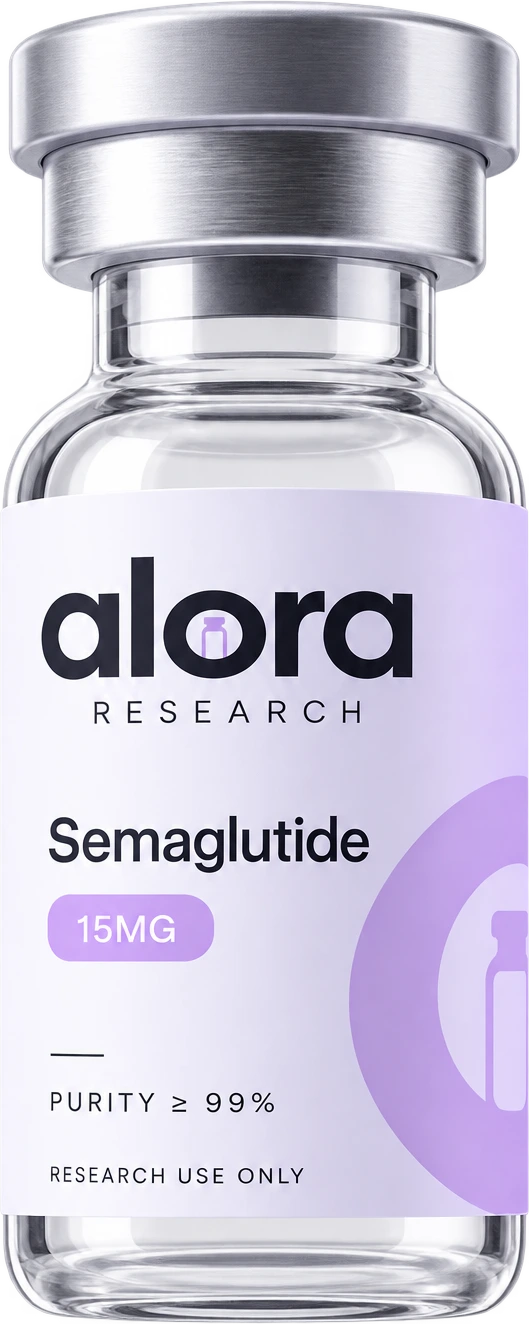
Catalog reference: Semaglutide.
What is known about semaglutide's chemical structure?
The development-review abstracts support a modified GLP-1 peptide with an albumin-binding design, but they do not provide a complete annotated molecular structure. [1, 2]
Acylation is a chemical modification that attaches an acyl group to a molecule. A linker connects molecular components. Dhillon's review identifies protein-acylation technology, while Knudsen and Lau describe optimization of fatty acid and linker combinations during development of liraglutide and semaglutide. [1, 2]
Catalog identity fields
- Research name: Semaglutide
- Catalog code: ALO-P-001
- Molecular formula: C187H291N45O59
- Molecular weight: 4113.6 g/mol
- Sequence entry: not specified
A molecular formula describes elemental composition; it does not specify how amino acid residues and attached chemical groups are connected. A peptide sequence describes the amino acid arrangement, while a complete modification map also identifies attached groups and their connection sites.
The cited development-review abstracts do not specify the complete sequence, residue-numbering convention, substitution positions, acylation site, linker structure, or fatty acid chain length. [1, 2] They therefore support a broad chemical-design explanation, rather than a verified residue-by-residue comparison of semaglutide versus GLP-1. [1, 2]
That distinction is important when reading a molecular identifier: composition, sequence, and attachment chemistry answer different questions.
How does semaglutide work at the GLP-1 receptor?
The development review identifies GLP-1 receptor activation as semaglutide's receptor-level mechanism and describes efforts to preserve receptor potency during molecular optimization. [2]
Binding describes association between molecules; receptor activation describes a functional response following receptor engagement. The development-review abstract does not provide quantitative receptor-binding constants, detailed activation-assay methods, or candidate-by-candidate assay results. [2] Its account supports the receptor target and design rationale, but not a numerical comparison of binding strength or signaling potency. [2]
Rodent experiments add a different kind of mechanistic evidence: Gabery and colleagues analyzed semaglutide access, GLP-1 receptor distribution, c-Fos activity, and brain connectivity. [3]
Those rodent findings do not establish matching localization or signaling patterns in human tissue. [3]
How is albumin binding different from receptor activation?
In the development review, reversible albumin binding is a molecular-persistence strategy, whereas GLP-1 receptor activation is the receptor-pharmacology component of the design. [2]
Reversible binding means that a molecule can associate with and dissociate from a binding partner. Knudsen and Lau describe selecting fatty acid and linker combinations to maximize albumin binding while maintaining GLP-1 receptor potency. [2] Their review abstract does not report an atomic binding arrangement, a numerical albumin-binding strength, or a complete linker structure. [2]
| Research question | What the literature reports | Abstract-level limit |
|---|---|---|
| Which receptor is involved? | The development review identifies GLP-1 receptor activity. [2] | No quantitative receptor-assay results are presented in its abstract. [2] |
| Why incorporate albumin binding? | The development review describes reversible binding as a strategy for prolonging molecular persistence. [2] | No atomic albumin-binding model is presented in its abstract. [2] |
| How is persistence investigated? | A systematic review examines human concentration–time measurements and pharmacokinetic parameters. [4] | Its abstract does not establish a residue-level explanation for each parameter. [4] |
Pharmacokinetics describes how a compound's measured concentration changes over time.
Neither development-review abstract reports experiments establishing resistance to a particular peptide-cleaving enzyme. [1, 2] Consequently, the albumin-binding account in these reviews does not itself verify an enzyme-resistance mechanism or identify a specific amino acid substitution responsible for it. [1, 2]
When was semaglutide first described in research?
The development-review abstracts do not establish the earliest semaglutide-specific publication, so their publication years should not be presented as a verified first-discovery date. [1, 2]
A publication-based timeline can still distinguish the kinds of evidence available:
- 2018: Dhillon's development review identifies semaglutide as a modified human GLP-1 analog and describes protein acylation as part of its development. [1]
- 2019: Knudsen and Lau's review presents the development of liraglutide and subsequently semaglutide, emphasizing reversible albumin binding and fatty acid–linker optimization. [2]
- 2020: Gabery and colleagues report rodent analyses connecting semaglutide localization, GLP-1 receptor distribution, and cellular-activity signals. [3]
- 2024: Yang and Yang's systematic review brings together 17 articles containing human pharmacokinetic data. [4]
These publications address different questions: molecular development, anatomical localization in rodents, and concentration–time behavior in human research. [1, 2, 3, 4] They are not interchangeable demonstrations of molecular structure.
The development review places semaglutide after liraglutide within work on long-acting GLP-1 analogs, but its abstract does not date the initial synthesis of semaglutide or the earliest GLP-1 experiments. [2] A review's publication year is therefore a literature milestone, not necessarily the date of the experiments it summarizes.
What can study records and lot documents establish?
The registry record describes study design, while the development-review abstracts describe molecule-level research rather than the identity of an individual catalog lot. [1, 2, 5]
NCT04560998 is a registered phase 3 study (see registry record) listed as completed, randomized, and placebo-controlled, with quadruple masking and an industry sponsor classification. [5] Masking means concealing study assignments from specified study roles. Those registry fields describe the study's organization; they do not report receptor-binding measurements or characterize a particular research-material lot. [5]
For documentation navigation, see the Certificate of Analysis (COA) library and How to read a Certificate of Analysis.
Keep separate questions separate when reading documentation: What molecule does a catalog entry identify? What measurements does a lot document report? What model did a publication investigate? A receptor mechanism, a registry design, and an analytical record are different evidence categories.
Do not read a molecule-level literature citation as a lot-specific analytical result.
What the research establishes / What it does not establish
What the research establishes
- The development reviews identify semaglutide as a modified human GLP-1 analog and GLP-1 receptor agonist. [1, 2]
- The development review describes reversible albumin binding and selection of fatty acid–linker combinations while maintaining GLP-1 receptor potency. [2]
- The rodent study analyzed GLP-1 receptor distribution, c-Fos activity, and brain connectivity. [3]
- A systematic review assembled 17 articles containing human semaglutide pharmacokinetic data. [4]
What it does not establish
- The complete peptide sequence, residue-numbering convention, exact substitution sites, and complete side-chain chemistry are not specified in the cited development-review abstracts. [1, 2]
- Quantitative receptor-binding constants, detailed activation-assay methods, and enzyme-resistance measurements are not reported in those development-review abstracts. [1, 2]
- The rodent localization study does not establish matching receptor distribution or signaling patterns in human tissue. [3]
- The development-review publication years do not establish the earliest semaglutide-specific molecular discovery date. [1, 2]
Evidence at a glance
| Study | Year | Model | What was reported | Source |
|---|---|---|---|---|
| Dhillon development review | 2018 | Review | This development review identifies semaglutide as a modified human GLP-1 analog developed using protein-acylation technology. [1] | [1] |
| Knudsen and Lau | 2019 | Review | This development review describes reversible albumin binding and fatty acid–linker optimization while maintaining GLP-1 receptor potency. [2] | [2] |
| Gabery et al. | 2020 | Animal model | The rodent study analyzed GLP-1 receptor distribution, c-Fos activity, and brain connectivity. [3] | [3] |
| Yang and Yang | 2024 | Review | This systematic review assembled 17 articles reporting human semaglutide pharmacokinetic parameters. [4] | [4] |
| NCT04560998 registry | 2020 | Trial registry | The registry lists a completed, randomized, placebo-controlled phase 3 study with quadruple masking and an industry sponsor classification. [5] | [5] |
Frequently asked questions
Is semaglutide a peptide?
The development review identifies semaglutide as a modified analog of the human peptide GLP-1. [1] The development literature describes its chemistry through protein acylation and an albumin-binding design. [1, 2]
What is the difference between semaglutide and GLP-1?
Semaglutide is identified as a modified human GLP-1 analog, rather than unmodified GLP-1, in the development review. [1] Knudsen and Lau describe fatty acid–linker optimization and reversible albumin binding during development of long-acting GLP-1 analogs. [2] Their abstract does not provide a residue-by-residue comparison. [2]
What is semaglutide's peptide sequence?
The cited development-review abstracts do not provide a complete peptide sequence or a residue-numbering convention. [1, 2] They support the modified GLP-1 identity and albumin-binding design, but not a fully annotated sequence map. [1, 2]
How does semaglutide bind to albumin?
Knudsen and Lau's development review describes reversible albumin binding and optimization of fatty acid–linker combinations. [2] Its abstract does not describe an atomic binding arrangement or report a numerical measure of albumin-binding strength. [2]
When was semaglutide first described?
Dhillon's 2018 development review identifies semaglutide as a modified human GLP-1 analog, but its abstract does not establish the earliest molecular-discovery date. [1] Knudsen and Lau's 2019 review provides a broader development narrative, including the albumin-binding strategy. [2]
References
- 1.Dhillon S Semaglutide: First Global Approval Drugs. 2018. PMID 29363040
- 2.Knudsen LB, Lau J The Discovery and Development of Liraglutide and Semaglutide Frontiers in endocrinology. 2019. PMID 31031702
- 3.Gabery S, Salinas CG, Paulsen SJ, et al. Semaglutide lowers body weight in rodents via distributed neural pathways JCI insight. 2020. PMID 32213703
- 4.Yang XD, Yang YY Clinical Pharmacokinetics of Semaglutide: A Systematic Review Drug design, development and therapy. 2024. PMID 38952487
- 5.A Research Study to Compare a Medicine Called Semaglutide Against Placebo in People With Peripheral Arterial Disease and Type 2 Diabetes ClinicalTrials.gov. 2020. NCT04560998