Tirzepatide vs semaglutide: receptors, structure and study design
Compare tirzepatide and semaglutide receptor targets, signaling evidence, structural descriptions, half-life evidence, and comparative study designs.
ALORA Research editorial teamPublished Last reviewed 7 min read

The short answer
Tirzepatide and semaglutide are incretin receptor agonists with different target profiles. A cell-based receptor-signaling study characterizes tirzepatide as a dual glucose-dependent insulinotropic polypeptide (GIP) and glucagon-like peptide-1 (GLP-1) receptor agonist, while a review classifies semaglutide as selective for GLP-1. Published abstracts support that mechanistic distinction but do not provide a matched numerical comparison of receptor affinity or elimination half-life.
Key facts
- Receptor targets
- Pharmacology review: tirzepatide targets GIP and GLP-1 receptors; semaglutide selectively targets GLP-1 receptors. [1]
- Mechanistic models
- Tirzepatide research includes cell-based receptor-signaling experiments, receptor-occupancy analysis, and primary islets. [2]
- Structural descriptions
- Reviews describe tirzepatide as an acylated peptide and semaglutide as a GLP-1 analogue. [1, 3]
- Half-life evidence
- A semaglutide review describes a long elimination half-life without a numerical value in its abstract. [4]
- Published direct comparison
- Human phase 1 study: randomized, double-blind, parallel-arm; 117 participants. [5]
- Comparative registry
- Registered phase 4 study: randomized, no masking, active but not recruiting. [6]
- Evidence synthesis
- Network meta-analysis of human randomized trials: 28 trials and 23,622 participants. [7]
- Catalog code
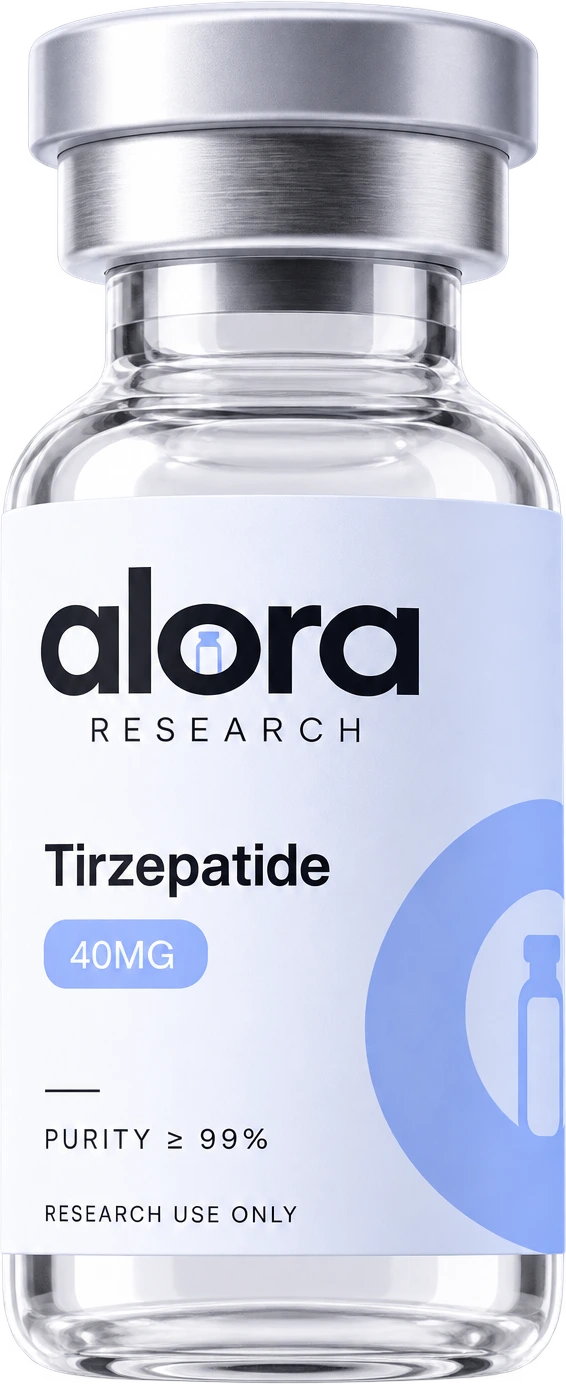
- ALO-P-002
- Molecular formula
- C225H348N48O68
- Molecular weight
- 4813.5 g/mol
- Classification
- Research peptide — laboratory use only
- Catalog code
- ALO-P-001
- Molecular formula
- C187H291N45O59
- Molecular weight
- 4113.6 g/mol
- Classification
- Research peptide — laboratory use only
What is the main receptor difference?
A pharmacology review classifies tirzepatide as a dual incretin receptor agonist and semaglutide as a selective glucagon-like peptide-1 (GLP-1) receptor agonist. [1]
An agonist is a molecule that activates a receptor, a protein that recognizes molecular signals. Incretins are peptide hormones involved in nutrient-responsive signaling. The relevant targets in the review are the receptors for glucose-dependent insulinotropic polypeptide (GIP) and GLP-1; tirzepatide addresses both, whereas semaglutide is described as selective for GLP-1. [1]
“Dual” identifies the receptor targets, not equal activity at those targets. In tirzepatide receptor-occupancy analysis, Willard and colleagues reported greater engagement of the GIP receptor than the GLP-1 receptor. [2] Receptor occupancy means the fraction of receptors occupied by a molecule under specified conditions.
For a useful comparison, keep receptor identity separate from receptor engagement and downstream signaling. These terms describe different questions: what a molecule activates, how extensively it engages a target, and what cellular signals follow.
What structural differences are documented?
The pharmacology reviews describe tirzepatide as an acylated peptide and semaglutide as a GLP-1 analogue, but their abstracts do not provide a full sequence-level comparison. [1, 3]
Acylation means attaching an acyl chemical group to a molecule. An analogue is a molecule structurally related to a reference molecule. These descriptions identify broad molecular features rather than a complete chemical specification.
| Feature described in reviews | Tirzepatide | Semaglutide |
|---|---|---|
| Receptor classification | Dual GIP and GLP-1 receptor agonist. [1] | Selective GLP-1 receptor agonist. [1] |
| Structural description | Acylated peptide. [1] | GLP-1 analogue. [3] |
| Full sequence in the cited review abstract | Not listed. [1] | Not listed. [3] |
| Numerical elimination half-life in the cited review abstract | Not listed. [1] | Not listed; described qualitatively as long. [4] |
The tirzepatide review abstract does not specify its attachment site, linker chemistry, or complete modification map. [1] The semaglutide review abstract identifies the GLP-1 analogue relationship without listing its amino acid substitutions or complete modification map. [3]
For catalog identity fields, consult the tirzepatide catalog record and semaglutide catalog record. Keep those identity fields separate from experimental evidence about receptor activity: a molecular formula is not an amino acid sequence, and a molecular mass is not a signaling measurement.
What do receptor studies actually show?
Willard and colleagues' calculated receptor-occupancy analysis indicated greater GIP receptor engagement than GLP-1 receptor engagement, while their cell-based signaling experiments reported a preference for particular GLP-1 receptor signaling outputs. [2]
Willard and colleagues reported that tirzepatide resembled native GIP at the GIP receptor in their cell-based pharmacological experiments. [2] At the GLP-1 receptor, their cell-based signaling experiments reported a preference for cyclic adenosine monophosphate (cAMP) generation over β-arrestin recruitment. [2] Here, cAMP is an intracellular signaling messenger, while β-arrestin is a receptor-associated regulatory protein.
Signaling bias describes a relative preference for signaling outputs within a specified experimental comparison. It is different from binding affinity, which describes how tightly a molecule binds its target, and potency, which describes the concentration needed to produce a specified response.
In the same cell-based receptor experiments, tirzepatide had a weaker ability to drive GLP-1 receptor internalization than native GLP-1. [2] Internalization means movement of receptors from the cell surface into the cell.
The reported cell-based internalization comparison used GLP-1 as its reference, rather than semaglutide. [2] Consequently, that cell-based result does not establish a direct tirzepatide–semaglutide difference in receptor internalization. [2]
The study's receptor-occupancy analysis also reported greater GIP receptor engagement than GLP-1 receptor engagement for tirzepatide, but its abstract does not present matched numerical binding-affinity constants for tirzepatide and semaglutide. [2]
Keep the experimental comparator visible: a comparison with native GLP-1 is not automatically a comparison with semaglutide.
Can half-life engineering be compared quantitatively?
The review abstracts support a qualitative description of semaglutide's long elimination half-life, not a numerical half-life comparison with tirzepatide. [1, 4]
Elimination half-life describes the time associated with a halving of concentration during elimination. Pharmacokinetics describes how a compound's concentration changes over time.
Christou and colleagues describe semaglutide as having a long elimination half-life in their review, but the abstract does not state a numerical value. [4] For tirzepatide, the pharmacology review's acylated-peptide description is not accompanied by a numerical half-life or a detailed explanation of the chemical features controlling it. [1]
These review abstracts therefore do not establish a numerical ranking of elimination half-lives or a detailed comparison of the molecular engineering responsible for persistence. [1, 4] They also do not provide a matched experiment linking a particular structural modification to a measured half-life difference between the compounds. [1, 4]
Keep the questions separate: which receptor is activated, what signaling pattern follows, and how concentration changes over time. A qualitative persistence description should not substitute for a measured comparative pharmacokinetic result.
How were direct comparative studies designed?
A published human phase 1 study directly compared tirzepatide, semaglutide, and placebo using a randomized, double-blind, parallel-arm design. [5]
In the study by Heise and colleagues, 117 participants were enrolled in a metabolic research population, with randomized allocation in a 3:3:2 ratio. [5] The human study assessed participants at baseline and week 28, and its abstract describes the study as complete. [5]
A parallel-arm design follows separate assigned groups. Randomization assigns participants by chance, while masking limits knowledge of those assignments. In this human study, the primary comparison was tirzepatide versus placebo; the tirzepatide versus semaglutide comparison was included among the secondary comparisons. [5] That distinction belongs in any account of the study's design, rather than presenting every comparison as its primary question.
A separate registry record, NCT06803888, describes a registered phase 4 study that includes semaglutide, tirzepatide, and another comparator. [6] The registered study is randomized, has no masking, and is listed as active but not recruiting. [6] Its sponsor class is listed as OTHER, and the registered primary assessment is at Week 52. [6]
The published phase 1 study and the registered phase 4 study therefore differ in comparator structure and masking. [5, 6] Neither design should be substituted for the cell-based receptor-signaling experiments when describing what was directly examined at the molecular level. [2, 5, 6]
How should direct, indirect, and lot-level evidence be separated?
The human comparative literature includes both direct study designs and a network meta-analysis, which are distinct from cell-based receptor experiments and catalog documentation. [2, 5, 7]
Karagiannis and colleagues' systematic review and network meta-analysis included 28 randomized trials and 23,622 participants. [7] The review allowed human trials comparing tirzepatide and semaglutide with each other, placebo, or other active comparators. [7]
A network meta-analysis connects comparisons across studies; it is not synonymous with a single head-to-head trial. For interpretation, identify whether a particular statement comes from a direct assignment comparison, a synthesis across studies, or an experiment examining receptor behavior.
The tirzepatide study's calculated receptor-occupancy analysis and cell-based experiments support a target-engagement and signaling distinction, but not a matched numerical affinity comparison with semaglutide. [2] The cited structural and half-life review abstracts likewise leave sequence-level engineering and comparative numerical half-lives unresolved. [1, 3, 4]
For material documentation, consult the COA library. A certificate of analysis (COA) records analytical testing associated with a material sample or lot. Use How to read a Certificate of Analysis as a separate documentation guide, and distinguish analytical records from the biological experiments cited for receptor activity.
What the research establishes / What it does not establish
What the research establishes
- A pharmacology review identifies tirzepatide as a dual GIP and GLP-1 receptor agonist and semaglutide as a selective GLP-1 receptor agonist. [1]
- In cell-based receptor-signaling experiments, tirzepatide favored cAMP generation over β-arrestin recruitment at the GLP-1 receptor and showed weaker receptor internalization than native GLP-1. [2]
- A semaglutide review describes a long elimination half-life, without a numerical value in its abstract. [4]
- A published human phase 1 study directly included tirzepatide, semaglutide, and placebo in a randomized, double-blind, parallel-arm design. [5]
What it does not establish
- The tirzepatide receptor-signaling abstract does not establish a matched numerical binding-affinity comparison with semaglutide. [2]
- The receptor-internalization comparison with native GLP-1 does not establish a corresponding difference between tirzepatide and semaglutide. [2]
- The cited structural review abstracts do not provide a complete sequence, attachment-site, or linker-level comparison of the compounds. [1, 3]
- The cited review abstracts do not establish comparative numerical elimination half-lives or a detailed comparison of half-life engineering. [1, 4]
Evidence at a glance
| Study | Year | Model | What was reported | Source |
|---|---|---|---|---|
| Nauck and D'Alessio | 2022 | Review | The pharmacology review describes tirzepatide as an acylated dual GIP and GLP-1 receptor agonist and semaglutide as a selective GLP-1 receptor agonist. [1] | [1] |
| Willard et al. | 2020 | Cell / in vitro | In cell-based receptor-signaling experiments, tirzepatide favored cAMP generation over β-arrestin recruitment at the GLP-1 receptor and produced weaker receptor internalization than native GLP-1. [2] | [2] |
| Christou et al. | 2019 | Review | The semaglutide review describes a long elimination half-life but does not report a numerical value in its abstract. [4] | [4] |
| Heise et al. | 2022 | Human study | The human phase 1 study enrolled 117 participants in a randomized, double-blind, parallel-arm comparison including tirzepatide, semaglutide, and placebo. [5] | [5] |
| NCT06803888 comparative study | 2025 | Trial registry | The registered phase 4 study includes semaglutide, tirzepatide, and another comparator, with randomized allocation, no masking, and active-not-recruiting status. [6] | [6] |
| Karagiannis et al. | 2024 | Review | The systematic review and network meta-analysis of human randomized trials included 28 trials and 23,622 participants. [7] | [7] |
Frequently asked questions
What is the main mechanism difference between tirzepatide and semaglutide?
A pharmacology review classifies tirzepatide as a dual GIP and GLP-1 receptor agonist, while semaglutide selectively targets the GLP-1 receptor. [1] In cell-based receptor-signaling experiments, tirzepatide also showed a preference for cAMP generation over β-arrestin recruitment at the GLP-1 receptor. [2]
Does dual receptor agonism mean equal activity at both receptors?
No: in tirzepatide receptor-occupancy analysis, Willard and colleagues reported greater engagement of the GIP receptor than the GLP-1 receptor. [2] Their cell-based receptor-signaling experiments also identified different signaling behavior at the respective targets. [2] Dual agonism identifies target coverage, not equal potency or identical signaling.
What structural differences are documented for tirzepatide and semaglutide?
The cited reviews describe tirzepatide as an acylated peptide and semaglutide as a GLP-1 analogue. [1, 3] Those review abstracts do not list complete sequences or modification maps, so they do not establish a detailed residue-by-residue comparison. [1, 3]
Which has the longer half-life, tirzepatide or semaglutide?
The semaglutide review describes a long elimination half-life but gives no numerical value in its abstract. [4] The cited tirzepatide and semaglutide review abstracts do not establish a matched numerical ranking of their elimination half-lives. [1, 4]
Have tirzepatide and semaglutide been compared directly?
Yes: Heise and colleagues published a human phase 1 study that included both compounds and placebo in a randomized, double-blind, parallel-arm design. [5] The tirzepatide versus semaglutide comparison was secondary, while the primary comparison was tirzepatide versus placebo. [5] A separate registered phase 4 study includes both compounds and another comparator and is listed as active but not recruiting. [6]
References
- 1.Nauck MA, D'Alessio DA Tirzepatide, a dual GIP/GLP-1 receptor co-agonist for the treatment of type 2 diabetes with unmatched effectiveness regrading glycaemic control and body weight reduction Cardiovascular diabetology. 2022. PMID 36050763
- 2.Willard FS, Douros JD, Gabe MB, et al. Tirzepatide is an imbalanced and biased dual GIP and GLP-1 receptor agonist JCI insight. 2020. PMID 32730231
- 3.Bergmann NC, Davies MJ, Lingvay I, et al. Semaglutide for the treatment of overweight and obesity: A review Diabetes, obesity & metabolism. 2023. PMID 36254579
- 4.Christou GA, Katsiki N, Blundell J, et al. Semaglutide as a promising antiobesity drug Obesity reviews : an official journal of the International Association for the Study of Obesity. 2019. PMID 30768766
- 5.Heise T, Mari A, DeVries JH, et al. Effects of subcutaneous tirzepatide versus placebo or semaglutide on pancreatic islet function and insulin sensitivity in adults with type 2 diabetes: a multicentre, randomised, double-blind, parallel-arm, phase 1 clinical trial The lancet. Diabetes & endocrinology. 2022. PMID 35468322
- 6.Bariatric Surgery vs. Semaglutide vs. Tirzepatide ClinicalTrials.gov. 2025. NCT06803888
- 7.Karagiannis T, Malandris K, Avgerinos I, et al. Subcutaneously administered tirzepatide vs semaglutide for adults with type 2 diabetes: a systematic review and network meta-analysis of randomised controlled trials Diabetologia. 2024. PMID 38613667