What is tirzepatide? Receptors, structure and research evidence
An examination of tirzepatide receptor pharmacology, signaling bias, experimental models, and gaps in abstract-level structure documentation.
ALORA Research editorial teamPublished Last reviewed 6 min read
The short answer
Tirzepatide is described as a dual agonist of glucose-dependent insulinotropic polypeptide (GIP) and glucagon-like peptide-1 (GLP-1) receptors. Receptor-occupancy analysis indicated greater engagement at GIP receptors than at GLP-1 receptors, while receptor-signaling studies reported distinct GLP-1 receptor signaling. The mechanistic abstracts describe receptor studies and murine tissue experiments but do not provide a complete amino-acid sequence or describe fatty-diacid modification chemistry.
Key facts
- Research class
- Dual GIP and GLP-1 receptor agonist in receptor-pharmacology studies. [1]
- Research identifier
- LY3298176 in the pharmacology report. [1]
- Receptor engagement
- Greater GIP-receptor engagement in receptor-occupancy analysis. [1]
- Signaling profile
- Distinct GLP-1 receptor signaling in receptor assays. [1]
- Animal research
- Mouse brown adipose tissue experiments. [2]
- Human comparison
- Semaglutide comparator in an open-label phase 3 study. [3]
- Registry example
- SURPASS-SWITCH: completed, randomized, open-label phase 4 study. [4]
- Catalog code
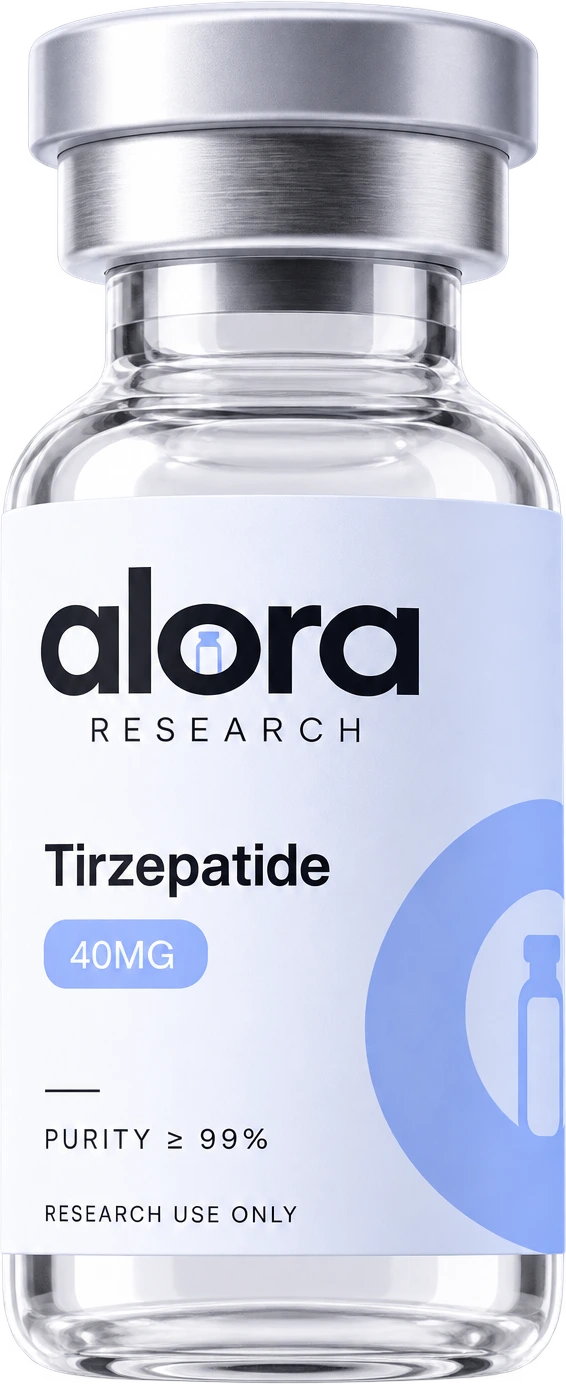
- ALO-P-002
- Molecular formula
- C225H348N48O68
- Molecular weight
- 4813.5 g/mol
- Classification
- Research peptide — laboratory use only
What does tirzepatide mean in receptor research?
Tirzepatide, also identified as LY3298176, is described as a dual glucose-dependent insulinotropic polypeptide (GIP) and glucagon-like peptide-1 (GLP-1) receptor agonist in the receptor-pharmacology report by Willard and colleagues. [1]
An agonist is a substance that activates a receptor. Receptor pharmacology examines how a substance interacts with receptors and produces measurable signals. The word “dual” identifies the receptor targets; it should not be read as a claim of equal activity at each target.
In receptor-signaling studies, tirzepatide mimicked native GIP at the GIP receptor but showed a different signaling pattern from GLP-1 at the GLP-1 receptor. [1] The authors described this profile as both imbalanced and biased. [1]
For comparison, the human study report by Frías and colleagues describes semaglutide as a selective GLP-1 receptor agonist and tirzepatide as a dual GIP and GLP-1 receptor agonist. [3] That distinction concerns receptor targets; it is separate from the design or findings of a human comparison.
What is documented about its sequence and fatty-diacid modification?
The receptor-pharmacology abstract identifies tirzepatide by name and research identifier, but it does not report a complete amino-acid sequence or describe a fatty-diacid modification. [1]
An amino-acid sequence specifies the arrangement of residues in a peptide. A fatty diacid is a fatty-acid-derived molecule with a carboxyl group at each end. Naming a modification is different from documenting its chemical structure, attachment site, and connection to the rest of a molecule.
The receptor-pharmacology abstract does not give a residue count, attachment site, or linker description. [1] The mouse tissue-study abstract likewise focuses on experimental measurements rather than sequence or modification chemistry. [2] Neither mechanistic abstract supports a detailed account of how a fatty-diacid modification affects tirzepatide's receptor behavior. [1, 2]
These omissions are limits of abstract-level documentation, not evidence that a particular chemical feature is absent. Sequence identity, modification chemistry, and receptor activity should be read as separate questions. A signaling result is not a substitute for a chemical structure, and a compound name alone should not be used to reconstruct missing structural details.
What do “imbalanced” and “biased” agonism mean?
In the receptor-pharmacology study, “imbalanced” refers to greater engagement of the GIP receptor, while “biased” describes the relative signaling responses measured at the GLP-1 receptor. [1]
Receptor occupancy means the fraction of receptors engaged by a substance. Signaling bias describes a relative preference for one measured signaling response over another. These terms address different questions: which receptor is engaged, and which signals follow receptor activation.
The study's occupancy analysis indicated greater engagement of tirzepatide at GIP receptors than at GLP-1 receptors. [1] In receptor-signaling assays, tirzepatide favored cyclic adenosine monophosphate (cAMP) generation over β-arrestin recruitment at the GLP-1 receptor. [1] Here, cAMP is an intracellular signaling messenger, and β-arrestin recruitment means the association of a receptor-regulatory protein with an activated receptor.
| Research question | Model or analysis | Reported observation |
|---|---|---|
| Which receptor showed greater engagement? | Receptor-occupancy analysis | Greater engagement at the GIP receptor than at the GLP-1 receptor. [1] |
| How did GIP-receptor signaling compare? | Receptor-signaling assays | Tirzepatide mimicked the actions of native GIP. [1] |
| Which GLP-1 receptor response was favored? | Receptor-signaling assays | cAMP generation was favored over β-arrestin recruitment. [1] |
| How did receptor internalization compare? | GLP-1 receptor internalization experiments | Tirzepatide showed weaker internalization than GLP-1. [1] |
Internalization means movement of a receptor from the cell surface into the cell. The weaker GLP-1 receptor internalization occurred alongside the signaling bias described in the receptor experiments. [1]
The pharmacology abstract does not report numerical affinity or potency ratios for these comparisons. [1] Affinity describes binding strength, whereas potency describes how much of a substance is needed to produce a specified response in an assay. The qualitative occupancy and signaling findings should therefore not be rewritten as an unsupported numerical selectivity ratio.
What do isolated-cell and mouse experiments add?
Primary-islet experiments addressed β-arrestin-dependent signaling, while mouse tissue experiments examined amino-acid metabolism. [1, 2]
Primary islets are clusters of pancreatic cells studied after isolation. In the primary-islet experiments, β-arrestin1 limited the insulin response to GLP-1, but not to GIP or tirzepatide. [1] The species used for those primary-islet experiments is not identified in the pharmacology abstract. [1] The authors interpreted the isolated-islet findings as suggesting a role for tirzepatide's signaling bias rather than establishing a complete causal mechanism. [1]
In a murine model, Samms and colleagues used stable-isotope tracer studies and metabolomic analyses to investigate branched-chain amino acids (BCAAs) and branched-chain keto acids (BCKAs) in brown adipose tissue (BAT) and other tissues. [2] A stable-isotope tracer follows labeled atoms through chemical transformations. Metabolomics measures small molecules within biological samples.
The receptor and mouse tissue abstracts do not demonstrate a direct causal connection between GLP-1 receptor signaling bias and the BAT amino-acid profile. [1, 2] Read the isolated-cell findings as evidence about signaling and the mouse tissue findings as evidence about measured molecular changes, rather than regarding them as interchangeable demonstrations.
What does the human study record establish about research design?
The human research record includes an open-label phase 3 comparison with semaglutide and a separate completed phase 4 registry record with dulaglutide as the comparator. [3, 4]
Frías and colleagues reported an open-label, randomized, 40-week phase 3 human study comparing tirzepatide with semaglutide. [3] Randomization means assignment by chance. Open-label means the assigned study intervention is not concealed from the relevant study participants and investigators.
SURPASS-SWITCH is a registered phase 4 study with randomized, open-label, active-controlled design (see registry record). [4] An active-controlled study uses another active intervention as the comparator rather than relying only on placebo. The SURPASS-SWITCH registry lists dulaglutide as the comparator, Eli Lilly and Company as lead sponsor, and an industry sponsor classification. [4] Its recorded status is completed. [4]
A registry's design fields describe the study, not receptor signaling. The human comparison abstract and SURPASS-SWITCH registry do not provide a complete amino-acid sequence or a chemical description of tirzepatide's fatty-diacid modification. [3, 4]
How should literature evidence and lot documentation be separated?
Literature citations and lot documentation answer different questions and should be read separately.
The receptor study reports occupancy analysis, signaling assays, and primary-islet experiments; the murine study reports tracer and metabolomic observations in tissues. [1, 2] Those are experimental findings, not substitutes for documentation about a particular research-material lot.
A Certificate of Analysis (COA) is a document recording analytical results for a material. Keep separate the identity assigned to a catalog entry, the findings reported in a publication, and the measurements recorded for a specific lot. A citation supporting receptor pharmacology should not be read as evidence that a particular lot was tested in that publication.
Documentation navigation: Tirzepatide catalog record, COA library, and How to read a Certificate of Analysis.
The directly reported mechanistic findings are the receptor-engagement pattern, distinct GLP-1 receptor signaling, isolated-islet observations, and mouse tissue molecular measurements. [1, 2] Complete sequence documentation, detailed modification chemistry, and a demonstrated causal connection between the receptor and tissue findings remain outside what these mechanistic abstracts establish. [1, 2]
What the research establishes / What it does not establish
What the research establishes
- The receptor-occupancy analysis reported greater tirzepatide engagement at the GIP receptor than at the GLP-1 receptor. [1]
- Receptor-signaling assays showed a preference for cAMP generation over β-arrestin recruitment at the GLP-1 receptor, alongside weaker internalization than with GLP-1. [1]
- Primary-islet experiments found that β-arrestin1 limited the insulin response to GLP-1, but not to GIP or tirzepatide. [1]
What it does not establish
- The mechanistic abstracts do not document a complete amino-acid sequence, residue count, or detailed fatty-diacid modification chemistry. [1, 2]
- The receptor-pharmacology abstract does not provide numerical affinity or potency ratios for the receptor comparisons. [1]
- The pharmacology abstract does not identify the species used for its primary-islet experiments. [1]
- The mechanistic abstracts do not demonstrate a direct causal connection between GLP-1 receptor signaling bias and the amino-acid profile measured in mouse brown adipose tissue. [1, 2]
Evidence at a glance
| Study | Year | Model | What was reported | Source |
|---|---|---|---|---|
| Willard et al. | 2020 | Cell / in vitro | In receptor-signaling assays, tirzepatide favored cAMP generation over β-arrestin recruitment at the GLP-1 receptor and showed weaker receptor internalization than GLP-1. [1] | [1] |
| Samms et al. | 2022 | Animal model | The study used a murine model, stable-isotope tracer studies, and metabolomic analyses of brown adipose tissue and other tissues. [2] | [2] |
| Frías et al. | 2021 | Human study | The human study used an open-label, randomized, 40-week phase 3 design comparing tirzepatide with semaglutide. [3] | [3] |
| SURPASS-SWITCH registry | 2022 | Trial registry | The registered phase 4 study is listed as completed and used a randomized, open-label, active-controlled design with dulaglutide as comparator. [4] | [4] |
Frequently asked questions
What receptors does tirzepatide activate?
The receptor-pharmacology report describes tirzepatide as an agonist of GIP and GLP-1 receptors. [1] Its receptor-occupancy analysis indicated greater engagement at the GIP receptor than at the GLP-1 receptor. [1]
Does dual agonism mean equal activity at both receptors?
Dual agonism identifies receptor targets; it does not by itself mean equal activity. In the receptor-pharmacology study, tirzepatide showed greater GIP-receptor engagement and a distinct signaling pattern at the GLP-1 receptor. [1]
What does biased GLP-1 receptor signaling mean?
Signaling bias describes a relative preference for one measured receptor response over another. In receptor-signaling assays, tirzepatide favored cAMP generation over β-arrestin recruitment at the GLP-1 receptor. [1] The same pharmacology report described weaker GLP-1 receptor internalization than with GLP-1. [1]
Do the mechanistic abstracts document tirzepatide's sequence and fatty-diacid modification?
The receptor-pharmacology abstract does not provide a complete amino-acid sequence or describe the fatty-diacid modification. [1] The mouse tissue-study abstract also does not document that chemistry. [2] These are documentation limits, not evidence that a particular structural feature is absent.
Which experimental models have been used to study tirzepatide's mechanism?
The pharmacology report describes receptor-signaling studies and primary-islet experiments. [1] A separate murine study used stable-isotope tracers and metabolomic analyses to examine amino-acid metabolism in brown adipose tissue and other tissues. [2] The abstracts do not establish a direct causal connection between the receptor-signaling findings and the mouse tissue profile. [1, 2]
References
- 1.Willard FS, Douros JD, Gabe MB, et al. Tirzepatide is an imbalanced and biased dual GIP and GLP-1 receptor agonist JCI insight. 2020. PMID 32730231
- 2.Samms RJ, Zhang G, He W, et al. Tirzepatide induces a thermogenic-like amino acid signature in brown adipose tissue Molecular metabolism. 2022. PMID 35921984
- 3.Frías JP, Davies MJ, Rosenstock J, et al. Tirzepatide versus Semaglutide Once Weekly in Patients with Type 2 Diabetes The New England journal of medicine. 2021. PMID 34170647
- 4.A Study of Tirzepatide (LY3298176) in Adult Participants With Type 2 Diabetes Switching From Dulaglutide (SURPASS-SWITCH) ClinicalTrials.gov. 2022. NCT05564039