
BPC-157 research: Models, mechanisms and human evidence
What do BPC-157 cell and animal studies, human-study reviews, and trial registry records establish—and what remains uncertain?
ALORA Research editorial teamPublished Last reviewed 7 min read
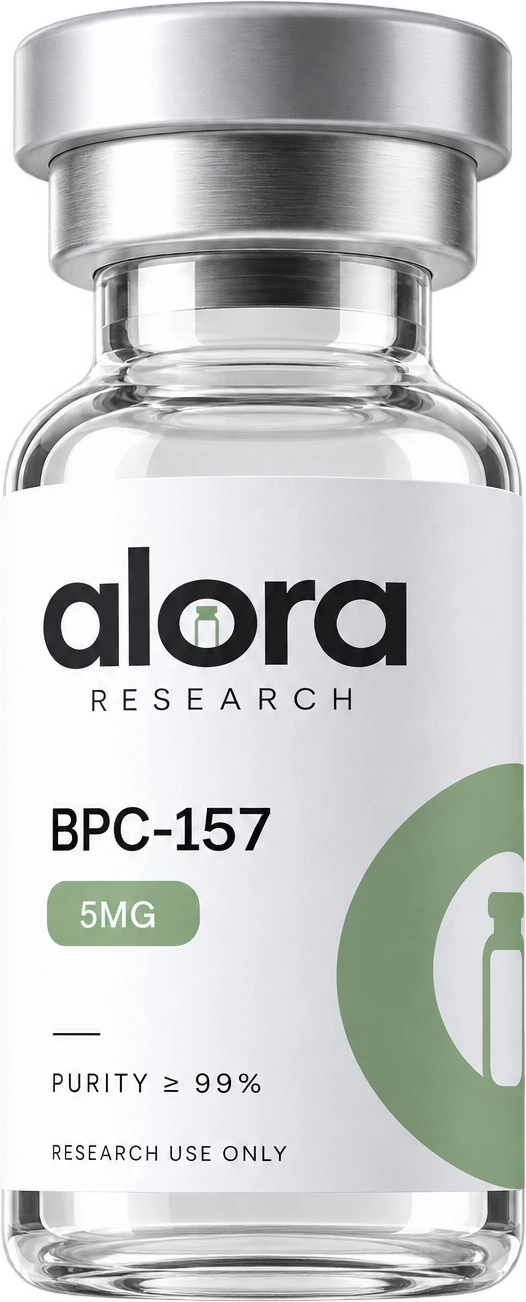
The short answer
BPC-157 is a synthetic peptide described in the literature as originating from gastric juice. Its research record is dominated by animal models and cell experiments, including vascular signaling and tendon-cell studies. Reviews describe limited human evidence, while registry entries document studies with differing statuses. Preclinical observations and registered study plans do not establish rigorous human validation.
Key facts
- Class
- Synthetic peptide described as originating from gastric juice [1]
- Reported sequence
- GEPPPGKPADDAGLV in the rat tendon study [2]
- Mechanistic focus
- Review-level summary of vascular signaling and cellular responses in animal-model research [1]
- Systematic-review composition
- 35 preclinical studies; 1 clinical study [4]
- Human-study record
- Three pilot studies discussed in a narrative review; rigorous large-scale studies lacking [1]
- Catalog code
- ALO-P-006
- Molecular formula
- C62H98N16O22
- Molecular weight
- 1419.5 g/mol
- Sequence
- GEPPPGKPADDAGLV
- Classification
- Research peptide — laboratory use only
What is BPC-157?
BPC-157 is a synthetic peptide described in a narrative review of animal and human research as originally isolated from gastric juice. [1]
A peptide is a chain of amino-acid units. The sequence identifies the arrangement of those units, while a study model identifies the experimental setting in which the material was examined.
The BPC-157 catalog record lists the sequence GEPPPGKPADDAGLV, which also appears in the primary paper describing rat tendon and cultured tendon-cell experiments. [2] That paper therefore supplies a published sequence reference alongside its experimental descriptions. [2] A sequence reference should not be confused with evidence that a particular catalog lot was evaluated in a published experiment.
The distinction between identity and evidence matters here: a review of the tissue-focused literature describes predominantly small-rodent research, and a systematic review likewise included predominantly preclinical studies. [3, 4] Preclinical research means experimental work outside human studies, including cell and animal models.
Which experimental models have researchers used?
The primary tendon paper examined both a rat Achilles tendon transection model and cultured tendon cells, providing distinct animal and cell settings rather than a human experiment. [2]
Transection means cutting across a tissue. In the rat model, the investigators used mechanical testing, microscopy, and macroscopic examination to assess the experimental tissue. [2] Those methods describe the animal study's design; they should remain distinct from the separate cell-culture findings.
In cultured tendon cells, BPC-157 alone did not stimulate growth, but it opposed growth inhibition associated with 4-hydroxynonenal, abbreviated HNE. [2] Serum is a blood-derived fluid fraction used in some cell-culture media.
The cultured-cell result was therefore conditional: the paper reported a response in the HNE-associated setting, not an independent growth response to BPC-157 alone. [2] Preserving that distinction avoids turning a specific laboratory observation into an unrestricted claim about cell growth.
At the review level, Gwyer and colleagues described a literature concentrated in small-rodent models and noted that only a handful of research groups had performed detailed investigations. [3] Their review also identified unresolved mechanistic questions. [3]
What does the mechanistic literature report?
Reviews of preclinical BPC-157 research describe several signaling pathways, but their abstracts do not establish a directly bound molecular target. [1, 4]
Signaling means the processes through which cells detect and respond to molecular cues. Direct binding is a separate concept: it means a physical interaction between a compound and a molecular target.
In its summary of preclinical research, the narrative review by McGuire and colleagues names vascular endothelial growth factor receptor 2, abbreviated VEGFR2, and nitric oxide synthesis through the protein kinase B–endothelial nitric oxide synthase axis, abbreviated Akt–eNOS. [1] An axis is a functional connection among signaling components.
The same review's preclinical summary also names extracellular signal-regulated kinase 1/2, abbreviated ERK1/2, and fibroblast activity. [1] Fibroblasts are connective-tissue cells. Angiogenesis, another term used in that preclinical review, means blood-vessel formation. [1]
The systematic review says its included studies suggest increased growth hormone receptor expression and involvement of pathways related to cell growth and angiogenesis. [4] Receptor expression refers to the production or abundance of a receptor; it is not synonymous with a compound binding that receptor.
Neither review abstract identifies direct BPC-157 binding to VEGFR2 or the growth hormone receptor. [1, 4] The defensible mechanistic summary is therefore a set of reported preclinical pathway associations, not a fully resolved receptor mechanism. [1, 4]
How extensive is the human-study record?
Reviews describe a small human-study record, with substantial limitations in study design and breadth. [1, 4, 5]
The systematic review by Vasireddi and colleagues included 36 studies: 35 preclinical studies and 1 clinical study. [4] It described the included human investigation as retrospective and reported that no clinical safety data were found within its reviewed literature. [4] A retrospective study examines information after the events being studied rather than assigning an experimental comparison prospectively.
The narrative review by McGuire and colleagues separately described three human pilot studies and emphasized the absence of rigorous, large-scale trials. [1] A pilot study is an exploratory investigation; its designation alone does not establish whether a later, more rigorous study confirmed its observations.
The narrative review by Mayfield and colleagues discussed a single BPC-157 human case series and identified significant methodological flaws and a lack of controls. [5] A case series describes a group without necessarily including a comparison group.
These review-level descriptions should not be added together as though they identify separate, nonoverlapping human experiments. The relevant distinction is between a review's included study set and the broader published record. The systematic review's predominantly preclinical composition and the narrative reviews' design concerns both support a limited, rather than mature, human evidence base. [1, 4, 5]
What do the trial registry records document?
BPC-157 registry records document randomized study designs with different phases and recruitment statuses, rather than a uniform set of completed human experiments. [6, 7, 8]
Randomization means assigning study groups by chance. Masking describes which people involved in a study are kept unaware of group assignments. A comparator is the reference group against which the experimental group is assessed.
| Registry record | Phase | Recorded status | Design and sponsor information |
|---|---|---|---|
| NCT02637284 | Phase I | Unknown | Randomized, quadruple masking, placebo comparator, industry sponsor. [6] |
| NCT07803250 | Phase 1 | Not yet recruiting | Randomized, quadruple masking, sham comparator, university sponsor. [7] |
| NCT07437547 | Phase 2 | Recruiting | Randomized, quadruple masking in the structured field, placebo comparator, industry sponsor. [8] |
For the registered phase I study, the official title identifies BPC-157 as the active ingredient, while the status field is unknown. [6] The university-sponsored registered phase 1 study is listed as not yet recruiting. [7] The industry-sponsored registered phase 2 study is listed as recruiting; its design details are in the registry record. [8]
The phase 2 record also contains a detail worth preserving: its official title describes double-blind masking, while its structured masking field says quadruple masking. [8] That discrepancy should remain visible rather than being silently reconciled.
Registration documents a study plan and recorded status; it is not a substitute for a published study report.
The registry entries broaden the documented human-study landscape beyond the case series discussed in the narrative review, but design fields alone do not resolve that review's concerns about published evidence quality. [5, 6, 7, 8]
How does lot documentation relate to the research evidence?
Lot documentation addresses the material record, while experimental publications address observations made in a specified model.
A certificate of analysis, abbreviated COA, is an analytical record associated with a material lot. Lot traceability means the ability to connect a material identifier with its corresponding records. Neither term is a designation for a cell experiment, animal study, or human study.
For document-level context, the relevant resources are the COA library and How to read a Certificate of Analysis. Keep the identity question, the analytical-documentation question, and the biological-evidence question separate when interpreting them.
For BPC-157, the primary tendon paper reports a sequence and experiments in rat tendon and cultured tendon cells. [2] The systematic review describes the composition of a broader literature, while the registry records describe human-study designs and statuses. [4, 6, 7, 8] These are different evidence categories. A careful summary preserves those boundaries instead of allowing a catalog identity, a preclinical observation, or a registry entry to stand in for the others.
What the research establishes / What it does not establish
What the research establishes
- The primary tendon paper reports the sequence GEPPPGKPADDAGLV and describes both rat tendon and cultured tendon-cell experiments. [2]
- In cultured tendon cells, BPC-157 alone did not stimulate growth but opposed growth inhibition associated with HNE. [2]
- The systematic review included 35 preclinical studies and 1 clinical study. [4]
- Reviews of preclinical research describe vascular signaling pathways and growth hormone receptor expression, without identifying direct binding in their abstracts. [1, 4]
- The registry records describe randomized human studies with unknown, not-yet-recruiting, and recruiting statuses. [6, 7, 8]
What it does not establish
- A directly bound molecular target is not established by the mechanistic descriptions in the preclinical review abstracts. [1, 4]
- Rigorous, large-scale human evidence is not established by the pilot studies summarized in the narrative review. [1]
- The systematic review did not identify clinical safety data within its included literature. [4]
- Broad independent replication is not established by the tissue-focused review, which described detailed research as concentrated among a handful of groups. [3]
Evidence at a glance
| Study | Year | Model | What was reported | Source |
|---|---|---|---|---|
| McGuire et al. | 2025 | Review | In a review of preclinical and human research, the authors described vascular signaling pathways and three human pilot studies while emphasizing the lack of rigorous, large-scale trials. [1] | [1] |
| Staresinic et al. | 2003 | Cell / in vitro | In cultured tendon cells, BPC-157 alone did not stimulate growth but opposed growth inhibition associated with HNE. [2] | [2] |
| Gwyer et al. | 2019 | Review | In a review of tissue-focused research, the authors described predominantly small-rodent models, a limited number of research groups, and unresolved mechanistic questions. [3] | [3] |
| Vasireddi et al. | 2025 | Review | In a systematic review, the authors included 35 preclinical studies and 1 clinical study and reported finding no clinical safety data. [4] | [4] |
| Mayfield et al. | 2026 | Review | In a narrative review, the authors identified significant methodological flaws and a lack of controls in a BPC-157 human case series. [5] | [5] |
| NCT02637284 registry | 2015 | Trial registry | The registered phase I study describes randomized allocation, quadruple masking, a placebo comparator, an industry sponsor, and unknown status. [6] | [6] |
| NCT07803250 registry | 2026 | Trial registry | The registered phase 1 study describes randomized allocation, quadruple masking, a sham comparator, a university sponsor, and not-yet-recruiting status. [7] | [7] |
| NCT07437547 registry | 2026 | Trial registry | The registered phase 2 study describes randomized allocation, a placebo comparator, an industry sponsor, and recruiting status, with differing masking descriptions in its title and structured field. [8] | [8] |
Frequently asked questions
What is BPC-157 in research?
BPC-157 is a synthetic peptide described as originating from gastric juice in a review of animal and human research. [1] A primary paper reports its sequence as GEPPPGKPADDAGLV and examines it in rat tendon and cultured tendon-cell models. [2]
Does BPC-157 have an established receptor target?
The cited preclinical review abstracts do not establish a directly bound BPC-157 receptor target. [1, 4] Reviews of preclinical research describe VEGFR2-associated signaling, Akt–eNOS signaling, and growth hormone receptor expression. [1, 4] Pathway involvement and direct receptor binding are different mechanistic claims.
What did the BPC-157 tendon-cell experiment report?
In cultured tendon cells, BPC-157 alone did not stimulate growth. [2] The same cell experiments reported that it opposed growth inhibition associated with HNE, including under conditions with serum and without serum. [2]
Has BPC-157 been studied in humans?
A narrative review describes three human pilot studies, while a systematic review included 1 clinical study within its own study set. [1, 4] Another narrative review identified methodological flaws and missing controls in a human case series. [5] Registry records also document randomized human-study designs with differing recruitment statuses. [6, 7, 8]
Are BPC-157 registry entries the same as published evidence?
A registry entry describes a study's planned or recorded characteristics; a published study report describes its investigation and findings. The BPC-157 records list unknown, not-yet-recruiting, and recruiting statuses. [6, 7, 8] Those statuses should not be read as interchangeable with completed, published experiments.
Does a certificate of analysis establish biological activity?
A certificate of analysis is a lot-level analytical record, not a biological study. The published BPC-157 tendon-cell findings come from a specified cell-culture experiment and belong to a separate evidence category. [2]
References
- 1.McGuire FP, Martinez R, Lenz A, et al. Regeneration or Risk? A Narrative Review of BPC-157 for Musculoskeletal Healing Current reviews in musculoskeletal medicine. 2025. PMID 40789979
- 2.Staresinic M, Sebecic B, Patrlj L, et al. Gastric pentadecapeptide BPC 157 accelerates healing of transected rat Achilles tendon and in vitro stimulates tendocytes growth Journal of orthopaedic research : official publication of the Orthopaedic Research Society. 2003. PMID 14554208
- 3.Gwyer D, Wragg NM, Wilson SL Gastric pentadecapeptide body protection compound BPC 157 and its role in accelerating musculoskeletal soft tissue healing Cell and tissue research. 2019. PMID 30915550
- 4.Vasireddi N, Hahamyan H, Salata MJ, et al. Emerging Use of BPC-157 in Orthopaedic Sports Medicine: A Systematic Review HSS journal : the musculoskeletal journal of Hospital for Special Surgery. 2025. PMID 40756949
- 5.Mayfield CK, Bolia IK, Feingold CL, et al. Injectable Peptide Therapy: A Primer for Orthopaedic and Sports Medicine Physicians The American journal of sports medicine. 2026. PMID 41476424
- 6.PCO-02 - Safety and Pharmacokinetics Trial ClinicalTrials.gov. 2015. NCT02637284
- 7.Impact of BPC-157 on Recovery Following Rotator Cuff Repair Surgery ClinicalTrials.gov. 2026. NCT07803250
- 8.BPC 157 for Acute Hamstring Muscle Strain Repair ClinicalTrials.gov. 2026. NCT07437547